Showing posts with label LotFP. Show all posts

Wednesday, May 2, 2012

Games to Play Before I Croak

A long time ago Beedo posted about the D&D modules he'd like to play before he "finally hangs up the dice for good." My own D&D "bucket list" includes not only modules but also some OSR-ish games I would like to play before my final days. To wit (and in no particular order):


- LotFP Grindhouse Edition: I hope I get to referee or play in an LotFP Grindhouse campaign at some point. Raggi has written a really clear and functional rules set and has added some inventive twists, in particular his Specialist Class, that I would love to road-test. Maybe Spawn of Endra could be persuaded to run LotFP one day?

- The Grinding Gear: Of all the Raggi modules I've seen, this is the one I most want to run a PC group through [see my review here]. Maybe as a one-off, or as a tournament module at some future convention. Maybe it could be done over two consecutive convention sessions.

- The Isle of Dread: Gods, this is the "classic" module I most want to run but never have. That dino on the cover has always appealed to me, as does the module's open-ended "sandboxy" nature. Viva Moldvay!


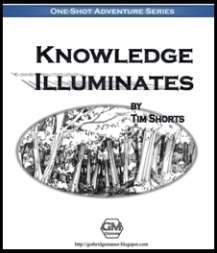
- Knowledge Illuminates: A strong module with which to kick off a campaign and/or unite a band of adventurers -- perhaps this may be run in my public gaming group in the coming year, or perhaps to start my next Arandish campaign, if the current one ever reaches an ending point. Tim Shorts' fresh, generative module is a terrific wilderness campaign-starter which I've reviewed here.


- Mutant Future: To be fair, I've played this one: I entered the OSR via Mutant Future, playing in Carl's awesome campaign which eventually wrapped up. One day I would like to run a Mutant Future campaign, or at least a few sessions of the game, to see how I like it. I have only played, but have never run, a post-apocalyptic game (outside of Shadowrun, a game I have run in the past but have little interest in playing again), and Mutant Future would probably be my system of choice, unless I get more serious about learning Twilight 2000.

- James Bond 007 or Top Secret: One day I will get around to running a "contemporary" espionage RPG, at least as a one-off or short "single mission" campaign, and it will likely be using one of these two systems.

"Hey Carter, can't we be friends?"

Monday, December 12, 2011

It's Vornheim, Charlie Brown!

Says Spawn:

Click to embiggen, naturally.
I took Saturday off from dissertation writing and in addition to starting a batch of sauerruben (fermented turnips) and listening to Wagner and Beethoven, I managed to throw the above image together. It had been percolating in my brain since being reminded of the Vornheim font by this post and learning it can be downloaded here. As was mentioned in the comments, it's so evocative of a specific work that it's not a super-useful font, but it can come in handy for, e.g., Vornheim greeting cards, or similar nonsense like the above.

Had I thought of this a few months ago, this would have been "It's the Great Peryton, Charlie Brown!" I'm sure you can use your imagination for that.

The image comprises elements of original works by Zak S., James E. Raggi IV, Charles M. Schulz, and Andreas Johansson (the electronic font), none of whose claims to copyright or whatever I challenge.

Wednesday, October 19, 2011

The Funk Bard David Snell: Giving the Party Bonuses to Certain Activities

Thinest Spawn McSays:

I was minding my business about Bards recently, since I got sort of burned out on the 2d6 Bard, and I think Beedo and Carter are onto a good thing with the LotFP Specialist Bard. And I'm not against bards fundamentally. I started up a new character in the ConstantCon session the other night, Chundarr the BardBarian. He's an S&W fighter, and since he had no cash he doesn't even have an instrument. But that's the fun. How do you have a Bard when there's just no such thing as a Bard in the system and you're not going to make one up? What a quandary!

No quandary at all, says I! I'm just going to play him as a Bard and be as bardly as possible in every fight and the bonus is not in PC morale or to-hit bonuses,  but in human-being player morale, a.k.a.: fun, laughter, camaraderie, nonsense, a good time. I spent a great deal of time in the last session thrusting a giant bat carcass on a stick in the faces of our foes, which is in-game barbaric and meta-game hilarious nonsense. I daresay it was BardBaric. Chundarr is learning to be a taunting monster puppeteer. We don't need rules for that. I don't anyway.

At any rate, there's this outstanding question in the blogosphericon about how a Bard playing a harp (or lute or whatever) can inspire anybody in a fight. Well, this may not be fight music, but this guy David Snell has the range that your classic Bard Harpist would need to be a real bad-ass. Check it out:


Maybe this works better at the tavern than in the dungeon, but even so he's not messing around with that harp.

Tuesday, October 18, 2011

Evil Gods and Summoners

I like evil gods. I like them a lot.

This is, in part, why I am immensely appreciative of James Raggi's discussion of alignment in his LotFP Grindhouse rules, about which I have mused at length before. The main idea is that Law and Chaos are palpable cosmic forces affecting the game-world, not just moral abstractions. So almost everybody in the human and demi-human species are neutral. Demons and the undead are aligned with Chaos, as are those who meddle in the arcane arts (which could simply be called "chaotic arts"). All clerics, unless they serve demons or chaotic demigods, are aligned with Law.

In some ways, this Law/Chaos business all ties back to the presumption of a multi-dimensional universe and the possibility for inter-dimensional travel: Law is what "naturally" occurs in one's home dimension, including its "indigenous" gods, and Chaos always comes from without, crossing into a foreign dimension via the energies of Chaos.

Again, I did not really make this up on my own, although it makes a lot of sense to me. I am once again indebted to Mr. Raggi, who succinctly describes arcane power thus:

"Magic fundamentally works by ripping a hole in the fabric of space and time and pulling out energy that interacts with and warps our reality. Various mages have managed to consistently capture specific energy in exact amounts to produce replicable results. Spells.

"The Summon spell opens the rift between the worlds a little bit more and forces an inhabitant into our world to do the Magic-User's bidding. What exactly comes through the tear, and whether or not it will do what the summoner wishes, are unpredictable."

[from the Summon spell description on Grindhouse Rules and Magic pg. 142]

This description fits perfectly with the core assumptions about how magic works in Ara. We have always included summoners as part of the Lands of Ara setting, and acknowledged in our own original writeup how dangerous Summoning could and should be. Summoning is a major part of what attracts demons -- i.e., Evil Gods -- to Ara in the first place. That is why it is technically an outlawed Art in the Lands of Ara now.

Yet Summoning surely still persists. Hell, the PCs in my current campaign are hot on the trail of some demonic entities that seem to have access to Summoner-created dimensional gates of some kind!

On a practical note, I wonder if I should technically make Raggi's Summon spell available in the Lands of Ara setting? Seems logical. . .

Friday, October 14, 2011

LotFP Specialist = The Future?

Inspired by Beedo's excellent take on the Bard, I have lately been oohing and ahhing over the LotFP Specialist class (described on pp. 10-11 and pp. 30-42 of Grindhouse Rules and Magic).  As Spawn of Endra comments on Beedo's blog, the latter's graft of Bardic skills onto the LotFP thief-substitute "points the way towards using the LotFP Specialist in new ways."

Indeed, to me the implications are quite clear: we should use LotFP's Specialist as a "conversion kit" for any custom class (or so-called "Advanced" class such as those in the Advanced Edition Companion) that we want to bring into our Basic D&D-ish games.  As Raggi himself puts it on p. 71 of Referee,

"Assassins and Bards are Specialists.  If the adventure or supplement text mentions specific power that these classes might have in other games, just grant it to the particular NPCs."

What Raggi suggests we grant to particular NPCs could be used, as Beedo has ably demonstrated, to streamline the process of bringing oddball PC classes like Rangers, Bards, and Jongleurs into the mix of our campaigns.  Need a sea pirate with sailing skill?  Make Sailing a Specialist skill and make Sailors Specialists.


Using this logic, I could port the Delving Deeper Bard over to the LotFP Specialist paradigm -- or, I suppose, simply steal Beedo's Bard.  I would also like to graft Ranger skills* like Tracking onto the Specialist chassis:

Tracking - "Familiar with the signs left by humans, humanoids, and various other creatures as they make their way through the wilderness, rangers can discover and follow the trail of those they are pursuing -- sometimes even in the worst of conditions."

So the standard Ranger (according to Brave Halfling) would have points in Tracking, Move Silently, Hide in Shadows, Bushcraft, and Hear Noise. Any Ranger wanting to take the "Damage Bonus" option instead of the "Additional Skills" option (see Delving Deeper: Ranger) -- I've been using the former to represent northern Achelonian monster fighters -- could simply spend one of their initial allotted skill points to gain that ability, maybe swapping out Hide in Shadows and/or Hear Noise and instead spending a point to get that damage bonus vs. evil humanoids and giants.

Under this system, the standard LL thief would simply be a Specialist who spends points on Pick Locks, Find and Remove Traps, Pick Pockets, Move Silently, Climb Walls, Hide in Shadows, and Hear Noise.

After chucking in the Bard and Ranger skills, and changing some of LotFP's thief skill names back to their Labyrinth Lord equivalents,** my custom Specialist Skill List would look like:

Architecture
Bushcraft
Climb Walls
Find and Remove Traps [EDIT: Tinkering in LotFP]
Hear Noise
Hide in Shadows [Stealth in LotFP]
Languages
Lore [described here]
Move Silently [Stealth in LotFP]
Open Doors
Performance [described here]
Pick Locks [Tinkering in LotFP]
Pick Pockets [Sleight of Hand in LotFP]
Search
Sneak Attack
Tracking [see Delving Deeper: Ranger or description above]


It is too late for me to make the LotFP Specialist conversion in my current Labyrinth Lord campaign, because it would seriously change the nature (and , I think, potency) of our home-brewed 2d6 Bard class, currently active in play.  But one day, after the current party retires or dies (TPK!), maybe I will run my NEXT Lands of Ara campaign using a more lean and mean ruleset, mostly using Labyrinth Lord but with the LotFP Specialist thrown in to replace all non-core custom classes including the standard LL thief. I would also be ditching all the AEC crap as well, except, perhaps, the expanded spell lists. But that is for . . . the future?

Labyrinth Lord is my lover. . . from Hell!

--
* I am stealing these Ranger abilities straight out of Delving Deeper: Ranger. Raggi's Bushcraft skill already covers foraging/wilderness survival (p. 33) as well as direction sense (p. 34).
** Thanks to Mr. Raggi for providing skill name conversion guidelines on p. 70 of Referee.

Friday, September 2, 2011

Review: LotFP WFRP Referee

This is Part 3 of a three-part review of James Raggi's Lamentations of the Flame Princess Weird Fantasy Role-Playing Grindhouse Edition. Part 1 reviewed the game's Tutorial book; Part 2 the Rules and Magic volume. This third and final installment will discuss Referee. [Note: This review will NOT take in "A Stranger Storm," the adventure included on pp. 77-95 of Referee.]

First, the cover. While I stated in my review of Tutorial that I liked its cover the most of the three Grindhouse tomes, Peter Mullen's superb cover of Referee may give that one a run for its money. Mullen has a lively, vaguely Erol Otus-esque style that really jumps off the page, and his Referee cover captures quite an interesting moment indeed. Well done!

The Referee book itself opens with prose I tend to associate with Raggi's writings on the Lamentations of the Flame Princess blog. He even admits right at the outset of the Referee volume that "this book is much more loosely written than the other material in this game. This is me, the author, James Edwrad Raggi IV, talking to you, the reader." Hooray for that! In some ways, this is the kind of prose that I have been waiting for (but have seen less of) in the other volumes of the game. If I am going to invest in James Raggi's Grindhouse game, I surely expect to get a healthy dose of James Raggi's unique gaming worldview and balls-out expository style. While the Grindhouse rules themselves (and of course the notorious illos) are obviously an expression of Raggi's POV, the first two rule books are written in a very straightforward way, for clarity, and while that is a plus when it comes to understanding the rules, it is a minus for those of us who enjoy and take inspiration from Raggi's usual no-holds-barred writerly voice.*

This Referee book is chock-full of that engaging voice plus a wealth of insightful perspectives on what it means to be an effective old-school referee.  In fact, should I wish to produce a non-system-specific "Primer on Old-School Refereeing," I could do a lot worse than to simply excerpt out pp. 2-6, 11-33, 45-46, and 62-68 from this volume.  It's that good.

After a page of introductory remarks, the Referee tome launches right into the basics of Refereeing, covering a wide array of relevant topics of which I will simply gloss over some favorite highlights:

- "When the dice go badly for the players, they should be thinking about how to not let a roll of the die be the sole determiner of their fates. And when the dice go a little too well for the players, the Referee should note what he needs to do to prevent a single die roll from determining the course of an entire adventure" (p.18). Raggi is nothing if not fair-minded, strongly advocating the roll of the dice over Referee fiat. No fudging the dice!

- "In-character favors and personal connections are a type of reward that isn't commonly used in this sort of game, but in a continuing campaign this could be extremely valuable" (p. 19). I use these kinds of "rewards" all the time, and appreciate Raggi mentioning them here.

- The whole section on "Variety" (pp. 19-20) is just golden, containing advice like: "Change elements of your adventures, and change them often. [. . .] Keeping a campaign fresh through constant variety is the key to maintaining interest, for the players and for yourself." Indeed! This is an important idea yet is not always given this much emphasis in other RPG'ing rulebooks I've seen.

- Here is Raggi's manifesto on "Railroading" (p. 20), reprinted verbatim:

Repeat after me:

"My adventures and campaigns will have no pre-set endings. Characters are not required to act as I wish them to act during the course of the game. It is natural player behavior to trash scenarios and take the game to places unforeseen."

He even prints this a second time, exhorting the reader to recite it aloud. Raggi means business here, and this is absolutely the right thing to emphasize. I only wish I had read (and recited aloud) these words back in 1992 or so; it would have saved me a few disastrous sessions during that heady period.

- In his section on "Using Published Adventures" (pp. 31-32), which I appreciated a lot, Raggi makes the following important observation: "Some referees are great creative thinkers and make excellent adventures, but not every Referee can manage these things. Running a great game requires different skills that creating a great adventure. Never feel like you're doing something wrong just because you didn't write everything that you use in your campaign."

- Then there's the "Don't Change Anything Else" section (p. 32), in which Raggi again reiterates his view on the value of using other people's modules: "The very advantage of using adventures written by others is defeated if you change every detail to more closely match your style. After you take away the elements that could harm your campaign and change the names and other such details to fit your campaign, leave the adventures alone. Run them in the spirit they were written." I struggle with this, liking to tinker with other folks' modules, but I absolutely agree with Raggi here in principle.

Next Referee tackles issues relating to "The Campaign," including:

- "As characters travel, more areas that began as mere concepts can be filled in and become true locations. Your world will grow organically" (p. 33). Hear, hear! This is exactly how world-creation should occur, IMO. For example, I didn't know jack shit about the Minochian town of Fortinbras prior to my current party's setting up home base there; we have co-created it through play. This is the essence of sandbox play and a superb strategy for older-school, lower-prep GM's.

- I am quite fond of the section on "NPCs" (pp. 45-46), and would particularly like to single out this sharp little tidbit for honorable mention: "Quick rule of thumb: Average NPCs that don't need a name unless a player asks just have average stats. The important NPCs get +3 in modifiers to spread around. [. . .] Next -step-down NPCs get +2 in modifiers, and more common 'lieutenant' personalities just get a +1."

- On page 46 I noted an in-text reference to the back cover NPC charts, which are GREAT:

A sample of LotFP Referee's awesome back-cover NPC table.

- A listing (with brief commentary) of some of the key OSR publishers (pp. 74-76), including Basic Fantasy RPG, Black Blade, Brave Halfling, Frog God, Goblinoid, OSRIC, and a few others. This is a smart thing to include, a nice resource for somebody (especially a Referee) just entering the OSR end of the hobby.

- BEST TABLE EVER (p. 76), which gives AC equivalents for LotFP, Labyrinth Lord, S&W (ascending and descending), OSRIC, and Basic Fantasy RPG. Well done!

In sum, this is the best of the three LotFP WFRP books, IMO.  It is certainly the most "Raggian" of the three volumes, and I think that it poignantly reminds us that Raggi is particularly insightful when it comes to effective techniques to use behind the screen.**  Not to diminish the Grindhouse game itself, but Referee is where its author really shines and I could easily see this book being sold as a stand-alone volume, perhaps in a slightly abridged version re-titled James Raggi's Essential Referee's Handbook.   I doubt Mr. Raggi has any interest in such a project, though, so for now I must simply recommend that you BUY GRINDHOUSE in order to acquire this book -- and the elegant, extremely well-produced game system to which it belongs.

--
*Raggi even says of himself on p. 2 of Referee that "I am a far better writer than I am a Referee, for sure" -- an interesting comment, to which I return when I talk about my experience of Raggi-as-Referee in the other footnote to this review.
** I can vouch for this firsthand, having played in one of the online playtest groups for "A Stranger Storm," the adventure included in Referee.  Raggi is an absolute delight as a DM, and is especially good at acting out the roles of the NPCs.

Thursday, June 30, 2011

Review: LotFP WFRP Rules and Magic

This post constitutes Part 2 of a three-part review of James Raggi's Lamentations of the Flame Princess Weird Fantasy Role-Playing Grindhouse Edition. Part 1 covered the game's Tutorial book; this portion will discuss the Rules and Magic volume. I will review the third and final volume, Referee, in the near future.*

If the Tutorial book was somewhat hit-and-miss in terms of addressing the veteran gamer well-versed in D&D's terminology and conventions, Rules and Magic gets right down to business. This is in fact one of the great strengths of Raggi's three-volume organizational scheme: all the introductory material is confined to the Tutorial, thereby allowing the Rules and Magic installment to run lean and mean. Immediately following the Table of Contents is a short chargen summary, instructions for rolling ability scores, a universal ability score modifier table, brief ability score descriptions, and character classes -- in other words, just what the veteran gamer would expect, very efficiently and clearly laid out. I am especially fond of Raggi's use of a single ability score modifier table -- it is indicative of the streamlined way Raggi presents all the rules herein.

In terms of character classes, most of Raggi's versions conform to "standard" D&D expectations, so I will only mention the two standouts: Fighters and Specialists. In LotFP WFRP, Fighters get a "to hit" bonus that exceeds that of all other classes, AND increases every time the Fighter levels up. This is such a simple and elegant "fix" to the common complaint that fighters gain less power at higher levels than, say, the spellcasting classes, that I wish the writers of 2nd Edition AD&D had thought of it instead of heading down the "weapon proficiencies" road instead. Maybe that would have kept later editions from degenerating into the whole "feats" mess. But I digress.

LotFP Grindhouse Edition provides further balm to the wounded soul of a skill-system hater by finally building one that feels simple enough (10 skills only!) and old-school enough (it uses d6s!) not to rankle a curmudgeonly old grognard like myself. The system is based on a "x in 6 chance" mechanic -- my favorite!** -- and exists in a kind of "default mode" for all PCs. That is, all PCs use the "x in 6 chance" rule for many common adventuring actions, such as climbing, searching, sleight of hand, and bushcraft (foraging for food etc.). But the Specialist, LotFP's substitute for the D&D Thief class, gets extra "points" with which to improve his or her chances to perform some of these skills; a specialist is simply "better at certain activities that all characters are able to do at a basic level" (p. 10). This "diffuse" skill mechanic (available to all PCs but enhanced for Specialists) avoids the stupidity of thief-only d% skill tables and is so elegantly common-sensical that this feature alone provides a huge lure for me to want to play this game. Well done Raggi!

In another example of Raggi's commitment to efficient information design, the table accompanying each class description provides not only level advancement and hit die data, but saving throws as well. What a revelation! This makes so much more sense, and would be far easier to track down during game play, than the "usual" practice of locating saving throw tables in some separate section of the rulebook. This is not meant as a slam against other game designers who have opted for that more traditional mode, but I admit I am really fond of Raggi's choice to list saving throws with the class descriptions, on the same table as the other level advancement numbers.

I have noted elsewhere how amenable I am to Raggi's "cosmic" take on the threefold alignment system, and won't repeat that assessment here.

Others have praised LotFP's encumbrance system, and it looks great to me as well. But I am a pretty damn laissez-faire tracker of encumbrance, and so may not be the ideal reviewer to comment on that subsystem in much depth. Instead, let me praise the "Adventuring: The Rules of the Game" (pp. 30-37) section of the rulebook more generally. As Jeff Rients has written:

LotFP shines as pretty much the tightest version of D&D I've ever seen. This virtue comes across most clearly in the section devoted to what I call "operations", i.e. how to open a door or check for traps or crap like that. Most reviews of most D&D descendants (and many whole games!) completely skip this stuff because it's usually boring to read, but in actual dungeoneering play these mechanics are crucial. LotFP delivers the best, most coherent set of operations rules I've ever seen.

Agreed! Highlights for me include the game's foraging and hunting rules (based upon the Bushcraft skill), its precise description of what constitutes "defeating an enemy" (and what doesn't), and its breakdown of mapping procedures. However, one rules choice described in this section puzzles me a little: a character is merely unconscious at 0 hp and does not die until reaching -4 hp. Why? I know Raggi is not the first game designer or DM to proffer such a system, but I guess this is an area where I simply prefer that hp 0 = death.

"Maritime Adventures" in Grindhouse follow similar rules to Labyrinth Lord, but with more boats listed on the table.

"Property and Finance" is an interesting section, very helpful for games with PCs approaching Name Level.  I may well borrow some of these concepts, like "Investments" and "Taxes," for my own Domain-Level Labyrinth Lord game.  We'll see.   

"Encounters" unfolds generally as one would expect it to, but with some nice enhancements not found in other games, such as rules for "Firing into Melee" (p. 59) and "Pursuit" (p. 61) which strike me as convenient, if not 100% necessary, at least not for me.  These are the kinds of things I enjoy ruling on in the moment of game play; but it is thoughtful of Raggi to include guidelines for them, especially for newer referees. 

As for "Spells," this review is getting too lengthy as it is, and I am not feeling inclined to go through the spell lists exhaustively at this point.  I know that Raise Dead and Resurrection don't exist in Grindhouse, and that Raggi has added many custom spells to the standard D&D roster.  Maybe I will post separately on this, maybe not.  

Similarly, I don't want to spend tons of time reviewing the Rules and Magic artwork, but I do want to reiterate my contention from the Tutorial book review that the layout and quality of the art throughout this game are absolutely top-notch. As usual, Raggi is setting a very high standard here, and there is really nothing I can say by way of complaint or critique. And since I am an amoral anarchist who does not believe in abstract "community standards" concerning such matters, I have nothing to contribute to the discussion of the artwork's content or subject matter, except possibly: it rocks! The art throughout vividly evokes the world Raggi wants us to see when playing this game, which is precisely what RPG rulebook art should do.


All that said, let me single out a few of my favorite pieces from Rules and Magic: its cover (by Jason Rainville, see top of post), the badass female specialist pic on pp. 12-13 (by Amos Orion Sterns), the remarkable Dean Clayton piece on p. 89 (check out the shading!), and the GREAT medusa illo on p. 70 (by Cynthia Sheppard, see cropped sample above) -- this last being a standout favorite of mine from the whole Grindhouse trilogy of volumes.

To conclude, I would echo James Maliszewski's recommendation that James Raggi "sell the Rules and Magic book separately from the [Grindhouse] boxed set" since "Rules and Magic [has] been combined into a single 168-page volume that contains everything a player would need to play the game." Agreed! I was fortunate enough to be one of the first 100 orderers of Grindhouse and as part of that deal, I got a spare copy of Rules and Magic thrown into my order. I am immensely thankful for this, since that is indeed the book GMs and players would want to refer to most during game play.  So let me say that again, just in case James Raggi is reading this review: PLEASE RELEASE THE GRINDHOUSE RULES AND MAGIC BOOK AS A STAND-ALONE PRINT PRODUCT.  There surely must be a market for that, yes?  For folks who want to play the game and own a print copy but don't wish to throw down the big bucks for the complete box?  Or would this violate Raggi's conception of the game as a three-volume entirety?

On that note, I shall conclude.  Just one more book to go. . .

[UPDATE: As JDJarvis notes below, the stand-alone Rules and Magic book is available as a free, no-art pdf downloadable here.]

--
* As I mentioned in the first part of my review, I am really taking my time reading these books. Raggi clearly put a great deal of effort into creating, laying out, and publishing this game, and as a bibliophile I cannot resist taking my sweet time looking through it and savoring what I find there. So don't be too surprised if a few weeks pass before you see the final installment of my review.
** Regular readers will know that I favor d6-based skill mechanics for Thieves and Bards in my current Lands of Ara campaign.

Tuesday, June 21, 2011

Alignment By Raggi (and Goodman)

Alignment in D&D has always somewhat vexed me. It is a concept I am still (after all these years) trying to make sense out of / make peace with.

Dedicated as I am to learning the Old Ways, I am really determined to try to come to grips with an exciting, generative interpretation of the "alignment" concept in D&D, specifically using the standard OD&D / Labyrinth Lord / B/X Threefold Alignment System, i.e., Law - Neutrality - Chaos only.

[Those interested in my prior statements / musings on this issue may consult this post on alignment languages in Ara, as well as my previous "State of the Union" on Arandish Campaign Alignment found here.]

As it happens, I was just discussing this very topic with Spawn of Endra last weekend. He and I were talking about what his character, Innominus, a Lawfully aligned Cleric, would do (or would feel most compelled to do) with the Chaotically aligned sword the party filched off the defeated Hobgoblin General back in Session 26 of our campaign. [We never quite answered that question.]

One thing I feel strongly is that each god or deity in Ara should be unique, and may have specific idiosyncrasies that do not quite "align" with the Threefold Alignment System. That is, gods and extraplanar beings may not necessarily have alignments.

That said, I DO want Law and Chaos to be palpable forces engaged in an ancient, cosmic battle in the "big picture" of my Lands of Ara campaign setting. This is not a specific idea that has existed in Ara prior to its current Labyrinth Lord-based iteration, but I am now looking for ways to integrate a big-picture conflict between two opposed cosmic principles into the game-world. Perhaps in time I will come up with specific names for these two opposed forces -- something like Ara (Law) vs. The Demon Plane (Chaos) -- but for now I want to puzzle it out using the game's default terms, Law - Neutrality - Chaos.

Enter James Raggi's LotFP Grindhouse Edition and its take on alignment, found on pp. 21-22 of the Rules and Magic book. Both Spawn and I took a look at that section during our talk last weekend, and lo! leave it to Raggi to cut through the bullshit and issue a concise, clear definition of how alignment can work in D&D:

"Alignment is a character's orientation on a cosmic scale. It has nothing to do with a character's allegiances, personality, morality, or actions. Alignments will mostly be used to determine how a character is affected by certain magical elements in the game."

I like that -- it is cosmic and "macro" rather than nitpicky and "micro." Raggi describes each alignment category as follows:

"Lawful: The universe has an ultimate, irrefutable truth, and a flawless, unchanging plan towards which all events inevitably march. As time moves on, all distraction and resistance to this plan falters until everything is in its perfect state forevermore, without alteration or the possibility of possibilities. Those who are Lawful in alignment are part of an inevitable destiny, but have no knowledge of what that destiny is and what their role will be in fulfilling it. So they are forever look for signs and omens to show them their proper way.

"Chaotic: The howling maelstrom beyond the veil of shadows and existence is the source of all magic. It bends and tears the fabric of the universe; it destroys all that seeks to be permanent. It allows great miracles as reality alters at the whim of those that can call the eldritch forces, and it causes great catastrophe as beings we call demons (and far, far worse) rip into our reality and lay waste to all. Everything that is made will be unmade. Nothing exists, and nothing can ever exist, not in a way that the cosmos can ever recognize. Those who are Chaotic in alignment are touched by magic, and consider the world in terms of ebbing and flowing energy, of eternal tides washing away the sand castles that great kings and mighty gods build for themselves. Many mortals who are so aligned desperately wish they were not.

"Neutral: To be Neutral is merely to exist between the forces of Law and Chaos. Mortal beings exist as Neutral creatures, and remain so throughout their existence unless taking specific steps (often unwittingly) to align themselves otherwise. In fact, most beings would be rather displeased with the notion of pure Law and Chaos, as they are defined in alignment terms. Even most who would claim allegiance to Law or Chaos are not actually Lawful or Chaotic. In the real world, every human being that has ever existed has been Neutral."

And lastly, Raggi's most provocative (and useful) declaration:

Clerics must be Lawful. Elves and Magic-Users must be Chaotic. All others are free to choose their alignment.

I hereby hork Raggi's notion that all clerics are Lawful, and that all magic-users and elves are Chaotic. Clerics follow the metaphysical "laws" of Ara, paying fealty to the gods. Magic-users and arcanists are messing with the "howling maelstrom beyond the veil of shadows and existence" that is Chaos.

As it happens, this ruling fits in beautifully with the history of arcane magic use on Ara, particularly its descent into "chaos" during the Old War.

And a postscript by Joseph Goodman [from an unrelated rpg geek thread] that really sums things up nicely:

Law is an alignment with Man; Chaos is an alignment with supernatural (or supra-mortal) powers. That frequently turns into a "good vs. evil" conversation because the supernatural powers aren't always acting in mankind's best interest! But it's not always the case.

Indeed! I think this captures the vibe I'm after quite nicely.

Sunday, June 19, 2011

Get Your Small Game On: The Joy of Cooking (1974 Grindhouse Ed.)

From Thoust Spawn:

In the midst of a garbagey OSR week, I found my thoughts turning to FOOD, since that is one of the few things I have never become fundamentally disillusioned by and bitter about. At one point I went over to The Happy Whisk’s blog for about an hour and just stared at all the great food pictures and read the nice comments and cheerful repartee to get a break from the BS. I have to say I consider myself an Old School cook, as well and Old School RPG player. There are many odd overlaps. For example, the copy of Joy of Cooking I own was a used copy given to me by a friend (as were my AD&D PHB and DMG), and it is the 1974 version.

People, let me tell you: This book is Old School. They give you everything you need to cook, and let your imagination do the rest. There are some very basic instructions here: e.g., they take the time to tell you how to make toast, non-judgmentally. There are also solid treatments of obscure foods you might encounter (e.g., p.512 covers Pigs’ Ears, Chitterlings [Chitlin’s], Cockscombs, and finishes with an advisory piece, “About Marrow”, wherein we learn marrow can be substituted for brains in any recipe – good to know!). Many recipes have to be house-ruled (always double or triple the amount of garlic in these recipes), and some are best ignored, like encumbrance rules. The 1974 JoC feels a lot like 1e AD&D to me: People take from it what they want, and nobody ever uses all the recipes. And despite the improved meal-resolution mechanics of later versions of JoC, some of the charm is lost in later revisions in the 90s. To wit, in a perverse Borgesian turn there's a section in the Cookbook entitled Game, just as in most RPGs you've got rules in the Gamebook for finding Wild Food.

Do people use these rules often? “Rations and Foraging” in the Labyrinth Lord Basic rules, p. 46, tells us that ‘scavenging’ for food can be “accomplished without hindering travel by gathering fruits, nuts or small animals” in the course of a day. Or you can hunt and not travel, and then you get better chances of success. Despite devoting a section to Foraging and Hunting in the rules of Mr. Raggi’s LotFP:GE (Rules and Magic, p.33) the actions described are only hunting (which is covered under the Bushcraft skill in the new rules) and not foraging. One expends d10 of missile ammunition in a day's attempt at gathering food.

For Raggi foraging = hunting = meat, unless we assume that d10 crossbow bolts are being sacrificed for a basket of elderberries, or sloe apples, or majestic camas bulbs. Or if Les Stroud is your ranger, he shot d10 servings of lichen tea off of a Douglass fir. Perhaps there are no plants in the icy Finnish wastes.

Now that you've got your quarry, what do you with it? My JoC has several recipes for Rabbit or Hare (skinning them shown above), followed by Squirrel and a nice illustration of how to deal with that little guy. Note that gray squirrels are preferred over red, which are "quite gamey" (Mr. Arkhein?).

After that we have Opossum, Porcupine, Raccoon, Muskrat, Woodchuck, Beaver (and Beaver Tail), Armadillo, and then of course Venison, Bear, Peccary, Wild Boar and Stuffed Boar's Head.

So there you have it. For those seeking some verisimilitude in foraging roleplay here's a good resource. It could also be a resource for simple hand-drawn illustrations, torture-porn, furries, and a raft of other unsavory practices. Such is the multifarious nature of a great work of literature.

[UPDATE: I just noticed a link to this great website on Christian's sidebar, The Inn at the Crossroads. Attempts to produce the great dishes of literature!]

[UPDATE 2: Here's an earlier post that would have benefited from some JoC help -- Blood Sausage Making.]

Thursday, June 16, 2011

Review: LotFP WFRP Tutorial


Having been one of the lucky "first 100" to order James Raggi's Lamentations of the Flame Princess: Weird Fantasy Role-Playing Grindhouse Edition, I have been slowly reading through the contents of the boxed set over the past couple of weeks, relishing the riches found within. What follows is part one of a three-part review of the game; my comments will be organized in the same manner as the game itself, i.e., Part 1 will cover the Tutorial book, Part 2 the Rules and Magic tome, and Part 3 the Referee manual. Let's begin!

First, a few general comments about the overall quality of this product. I am not the first to observe that James Raggi is arguably the most quality-driven publisher in the OSR gaming business. His products (since at least Death Frost Doom) are consistently of very high production value, with evocative original artwork, superb layout, and (for the most part) a clear, effective, and engaging writing style. LotFP Grindhouse is no exception -- in fact, it is more or less the highest-quality OSR product I have yet seen, its nearest equivalent being Zak S.' Vornheim, also recently published by Raggi.* I ask the reader to bear in mind this general assessment of Raggi's work in what follows, for when I critique aspects of Grindhouse, I am in some ways judging Raggi against his own incredibly high standards, and even my negative comments should be seen against a backdrop of general awe for what Raggi's LotFP (the company) has accomplished here. Also note that I do not own and have only cursorily glanced at the previous Deluxe Edition of LotFP WFRP, so my review takes the new Grindhouse Edition at face value, on its own terms.

The Tutorial book sports my favorite cover image of the trilogy, created by Aeron Alfrey and visible in its draft stages here.

Indeed, the art in general is very good in this book, and there is a surprisingly coherent feel to the artwork throughout. My concern all along has been that by involving himself with such a wide variety of contributing artists and by emphasizing the artwork so heavily (especially leading up to Grindhouse Edition's release), Raggi might over-extend himself or get so obsessed with the artwork that it would become too much a focal point. But I don't think that that has happened. The art balances nicely with the text and there isn't too much of it. Beyond the Tutorial's excellent cover, I am particularly fond of the images found on pp. 3, 15, 50, 54, 77, and 90 -- yet the artwork is terrific throughout.

The bulk of the Tutorial volume is taken up with two introductory "adventures" presented as choose-your-own-adventure type narratives which gradually introduce core gaming concepts to the reader, like the role of attributes and what happens during melee combat. As James Maliszewski has noted in his review of Grindhouse, this CYOA-style tutorial is not necessary for veteran gamers, and may even seem counter-intuitive (why use a narrative "story" to teach gaming concepts?) or too long and involved (the two tutorial "adventures" run 41 pages taken together) even for a novice. Some would ask, "why not just plunge the neophyte gamer into the core rules mechanics, i.e., rolling 3d6 for each attribute in order?" That seems to be Maliszewski's implication and it is, at least for us grognards, a valid stance to take.

Ultimately, however, I feel unsure on this point; like Maliszewski, I learned to play D&D from a combination of reading certain books (Holmes Basic, the AD&D Player's Handbook) and playing the game with more experienced players. So I have never had to learn D&D (or any subsequent RPG) strictly from a book, and therefore I don't know how best to create that kind of interface for the type of reader at whom this section is aimed. I think what Raggi is trying to accomplish on pp. 5-46 of the Tutorial book is to get the neophyte's mental feet wet without really crunching any numbers yet, but I honestly cannot judge how effective this part of the book is at accomplishing its intended goal.

That said, I really like the various tidbits of wisdom Raggi offers on pp. 47-55, under such headings as "More About The Game," "The Process of Play," "About the Rules," and "Winning and Losing." This whole cluster of short sections was my second-favorite portion of the book, after the "Recommended Reading" segment.

Ah, the "Recommended Reading" segment. This is far and away my favorite part of the Tutorial book, for it provides what I always hoped everybody else's "Appendix N" would: a prose essay contextualizing the work being recommended. More than just a list of books to read, Raggi (and his collaborators**) discuss certain key authors and (most importantly) tell us why we should read that author's works. This approach empowers the reader with information, a strategy which allows each reader to make informed choices about which authors (and works) to read first, last, or not at all. And the write-ups of each key author are very good -- overall, a highly recommended section.

Lastly, there is the "Glossary" on the back cover -- a nice touch, conveniently placed. A very smart use of that space given the book's function as a tutorial volume.

To sum up, while there is much here for the for the veteran gamer to skip over, and while I cannot say for sure how or if the choose-your-own-adventure style tutorials would work effectively to introduce a neophyte to the game, the LotFP WFRP Grindhouse Edition Tutorial is a well-produced tome that is highly appropriate for inclusion in a boxed set. Plus there are several gems herein -- the "Recommended Readings," some gaming wisdom in the last third of the book, the impressive artwork throughout -- that are sure to at least make enjoyable reading for the veteran RPG'er. I shall withhold "scoring" Raggi's game until I have read and reviewed the second two books, but for now, let me state that I am impressed with Tutorial's aesthetics and layout, and while its content hasn't fully satisfied me as an experienced gamer, it has surely whetted my appetite to get a look at the frikkin' rules!

Next volume, here I come.

--
* Review forthcoming.
** The "Recommended Reading" section is co-authored by Raggi, Michael McClung, Jukka Sarkijarvi, Scott S., David Larkins, James Murphy, Chris Hogan, and Juhani Seppala.

Saturday, April 9, 2011

H for Hammers of the God

[Note: Any non-gamers tuning in to this series of posts are invited to consult my New Reader Introduction for some RPG-specific definitions and a general introduction to the Lands of Ara blog.]

Hammers of the God is at once James Edward Raggi IV's most conventional and most unusual module.  Its conventionality lies in the fact that it is more or less a standard dungeon crawl: along with Part Three of No Dignity in Death - The Three Brides, Hammers of the God is the least goal-oriented of Raggi's modules to date.  [Note that my comments exclude his recent LotFPWFRPG modules, Tower of the Stargazer and Weird New World, which I have not yet read.]  In Hammers, the PCs know very little about the dungeon location before they arrive, and even once they get there, their main goal is to "explore."  This conventionality of design and emphasis on exploration will make this module very appealing to a wide array of OSR gamers.

The unusualness of Hammers of the God comes mostly from its backstory, which, as I've suggested, only emerges in full once the PCs arrive on site (if at all).  The historical narrative that Raggi has created for the dwarves who built the Hammers dungeon is quite an achievement in itself, a haunting, pathos-laden tale that will substantially enrich how most fantasy campaigns conceive of dwarves as a race.  This "alternate history" for dwarves is exemplary of the kind of unique, outside-the-box thinking that we have come to expect from James Raggi, and may be worth buying the module for even if you never run the module itself. 

But this uniqueness may also serve as a kind of limitation upon how the module can be most effectively used.  Although there are more than a few really memorable and challenging locales in the dungeon -- without giving anything away, a certain bridge and the whole colored mist concept leap to mind -- the real "charge" of the module, the thing that makes it pay off in spades, is that haunting history of its builders that's waiting in there to be discovered.  What this means is that if you are not interested in exploring the nuances of dwarven history in your home campaign, or if -- like me -- you play in a campaign setting whose dwarves are flat-out incompatible with the history given in Hammers -- the impact of this module may be somewhat diminished.

Don't get me wrong: Hammers of the God is an excellent dungeon crawl, and (of course) clever DMs could reshape and revise that detailed back story to suit how dwarves "work" in their own campaigns.  Yet as a location-based adventure, Hammers taken separately from that mind-blowing alternative dwarven history is merely an excellent, not amazing, module.  This must sound like an incredibly petty quibble, and it is, but through his previous releases Raggi has set the bar very high for himself.  I (perhaps unfairly) tend expect great things from LotFP, and -- please note -- I am rarely disappointed.  To be clear, I am not disappointed in Hammers of the God either, but, perhaps because it will require such substantial tweaking on my part to bring it into line with the history of my own Lands of Ara campaign setting, I am saddened by the fact that I will not be able to use some of the greatest stuff in it strictly as written.  So my perception of Hammers' greatness is tinged with personal sadness.  Obviously that is a problem specific to my situation, but it could come up for other DMs whose home settings feature unique dwarvish histories as well.

More generally, I am ready to see Raggi tackle a module of Hammers' stripe -- a haunting but not horrific dungeon-crawl -- that features a "Circular Routes" layout, that is, an even more open-ended, site-based adventure than Hammers is. Pardon the possibly facile comparisons, but if The Grinding Gear is Raggi's Tomb of Horrors and Hammers of the God his White Plume Mountain, then where, I ask, is his Vault of the Drow?  Raggi has shown again and again that he is capable of creating modules with unique, memorable premises and inventive, well-designed individual rooms and challenges.  Hammers of the God is as close as Raggi has come to creating something that is fairly easily assimilable by all we heavily Gygaxian, high-fantasy influenced DMs, which is interesting given that Raggi himself emphasizes, in the Author's Introduction to Hammers, that

"when I run someone else's adventure, it's because I want the challenge of running something different [. . .] I think a referee can only benefit from taking another's adventure and adapting their style to the author's presentation, instead of doing the commonly-vaunted reverse method of always adapting published material to the referee's own campaign." 

I love the work Raggi has published so far, will continue to buy his products, and admire his stated goal to push many of us out of our DM'ing comfort zones.  Nevertheless I wonder: could Raggi take the Hammers-esque dungeon-crawl concept to the next level?  Pretty please?

Creativity and inspiration-value: 4 out of 5, the best part may well be the chilling dwarven back story, though the map is also quite good, if somewhat limited.
Use-value to DM's: 4 out of 5, would make a worthwhile (if less impactful) adventure even if the aforementioned history is of little interest.
Playability: Not yet tested.

Friday, April 8, 2011

G for The Grinding Gear

[Note: Any non-gamers tuning in to this series of posts are invited to consult my New Reader Introduction for some RPG-specific definitions and a general introduction to the Lands of Ara blog.]

As a self-proclaimed big fan of Gary Gygax's classic Tomb of Horrors module, it stands to reason that I would find a lot to rave about in James Edward Raggi's masterpiece The Grinding Gear.

Yes, you read that right: I call this module a "masterpiece," in large part because it illustrates a facet of Raggi's module-writing talents that goes somewhat under-deployed in all his other works: ingenious dungeon design.  And by "dungeon" I mean the actual physical layout of the dungeon, NOT the overall adventure concept, which Raggi always delivers with great inventiveness and panache.

Just as Gygax's Tomb did so much with so little -- i.e., became the single most notorious "deathtrap" dungeon of all time in a mere 33 keyed locations on a single level -- Raggi's Grinding Gear takes an extremely simple, almost overly contrived premise -- that a bitter inventor / innkeeper creates a tomb for himself that is also a devious "deathtrap"-style test of adventurers' abilities -- and makes it sing.  The Grinding Gear is a perfect vehicle for the trap-inventing, blackly humorous Raggi that, as I said before, often takes second chair to the uncanny, weird-mood-evoking, horrific-apocalypse-creating Raggi we see at work in, for example, his most famous and celebrated module, Death Frost Doom.

Without sidetracking too far here, let me state that I am by no means complaining about the horror-evoking Raggi.  In some ways, unnerving horror is what Raggi does best, and it is difficult to imagine anyone else coming up with the death cult shrine of Death Frost Doom, the melancholy locale outlined in Hammers of the God, or the queer town of Pembrooktonshire.  But my point is that of the works just mentioned, both DFD and the first two Parts of No Dignity In Death are geared much more toward evoking a feeling of dread and testing player's wits than they are about "traditional" dungeoneering activities.  And while the last section of No Dignity and all of Hammers of the God are arguably more "classic-dungeon-y" than DFD or Pembrooktonshire, they are nevertheless tinged with strong elements of haunted pasts, uncanny occurrences, and creeping horror, all of which characterize the "usual" Raggi style.

Not so The Grinding Gear.  The horror is gone, replaced with a capricious, black-comic wickedness.  And back to the dungeon layout: without giving too much away, suffice to say that GG's is the most complex map yet published in a Raggi module (possibly excepting the recent LotFPWFRPG modules, which I have not seen).  Admittedly, to use Melan's old-school dungeon layout terminology, GG is a Type B "Linear with Sidetracks" dungeon, as virtually all of Raggi's modules are.  But the "sidetracks" in a module like this are the whole point.  Whereas I loved the tone of DFD, and must point out that it is the one Raggi module to feature a Type D "Circular Routes" layout, it nevertheless feels somewhat linear or uni-directional in the sense that the "crux" of the module lies in one key location, and while there are two ways to get there, that one location is still the focus or fulcrum of the adventure -- not much "happens" anywhere else.  In The Grinding Gear, the map's linearity is a strength; it forms an escalating series of dungeoneering challenges that perfectly articulates the logic of the module, just as a similar linearity does in Tomb of Horrors.  The whole point of The Grinding Gear -- expressed in no uncertain terms to its visitors -- is to reach the final resting place of the dungeon's creator, and in such a goal-oriented place I would expect a certain uni-directionality of design.

All this mention of Gygax's Tomb of Horrors forces me to clarify: except in the most superficial way, The Grinding Gear is NOT some cheap copy or toned-down reiteration of the Tomb premise.  No, it is more than that.  It is nothing less than a high-stakes test of the party's dungeoneering / exploration skills.  One could make a similar argument for Acererak's tomb, yet that place has an added level of random (?) sadism: certain traps (like the green devil face) and situations (like fighting the demi-lich) make Module S1 all but impossible to defeat.  Of course, that extreme lethality became part of Tomb's appeal over time, but The Grinding Gear's great triumph (and thus its utility) is that it is not impossible, but merely intensely challenging, to "beat."  While a few of the traps will depend upon a very high degree of PC observation skill and exploration ability to successfully bypass, there is nothing in Gear that makes me say, "Wow!  If the PCs go in there, they are fucked no matter what."  It is my strong suspicion -- as yet untested in actual game play -- that The Grinding Gear is survivable by a reasonably well-equipped party who makes a strong commitment to proceeding carefully and thoughtfully, paying close attention to even mundane-seeming details.  In short, The Grinding Gear is NOT a deathtrap, although it can easily become one for the ill-prepared or the rash.

As James Maliszewski has commented, this module may be of some use to DM's who simply want to pilfer trap ideas from it.  Yet I am inclined to suggest that the real strength of The Grinding Gear is in its holistic construction, the way its parts interact to create a satisfying whole.  There is a nice balance here between premise and playability, a balance that even the great Death Frost Doom (which may possess a bit more strength of premise than thrill of playability) does not quite achieve in my view.  In line with this, while some traps could easily be cherry picked from The Grinding Gear for use elsewhere, certain others would require substantial reworking because their "solution" is intrinsically linked to features of the location as Raggi presents it.  In short, while I am sure certain elements of the module could be useful in a modular sense, I think The Grinding Gear's real value -- the reason I consider it to be at least the equal of Death Frost Doom in terms of overall brilliance -- is its organic unity, i.e., how I suspect it would run in play exactly as written.

If the module has a weakness, it is that it would be no fun for a "hack-and-slash" style party to play through.  But then again, what Raggi module would be?  Raggi always has the thinking player in mind, and The Grinding Gear may be his best and most fun challenge yet for that kind of player and party.  There is no sense of creeping terror here, no undead apocalypses or murder mysteries; yet puzzling conundrums, exploration-based tests of skill, and black humor abound, all of which combine to make this one of the most accessible and coherent Raggi modules to date.  I cannot wait to run it with the right group of players -- I wonder if my current group is up to taking on the devious mind of Garvin Richrom?

Creativity and inspiration-value: 5 out of 5, especially if you have been looking for a Tomb of Horrors style challenge geared (ha, ha) to lower-level players.
Use-value to DM's: 4 out of 5, if party is up to the challenge of running the module as is or possibly if you want to "borrow" some good trap ideas.
Playability:  Not yet tested, but hopes are high!

Tuesday, February 1, 2011

Review: No Dignity In Death

I recently bought a few James Raggi IV products I hadn't gotten around to buying previously: No Dignity in Death - The Three Brides, People of Pembrooktonshire, and Hammers of the God.  I am a big fan of Raggi's writing style and his unique, horror-and-heavy-metal-influenced perspective on our beloved RPG'ing hobby.  So I always enjoy reading his works for inspiration even if I am sometimes at a bit of a loss for how exactly to fit some of them into my own Lands of Ara campaign.

But reading No Dignity In Death was a particular treat for me, so I felt inspired to review it here.  Note that I have NOT run the module yet in a play situation, so this review is based upon a read-through only.  Also note that there will not be any spoilers in this review, both out of deference to readers who plan to DM or play it and because I am so taken with No Dignity In Death that I hope to run (at least parts of) it in my own campaign one day.

As its subtitle (The Three Brides) suggests, No Dignity In Death consists of three parts, each of which may be run separately from the others.  In his introduction to the module, Raggi reveals that this is how the three sections came to be -- as separate, unconnected adventures he ran in his home campaign.  I like that he provides a thumbnail sketch of a strange, isolated mountain town -- Pembrooktonshire -- and uses it as the "glue" to hold these three very different adventures together.

In a moment I will address each of the three "adventures" included in the module, but allow me to state up front how intriguing I find Pembrooktonshire.  I admit that I am a big fan of "town adventures," for as DM I get a big kick out of playing a wide assortment of NPC's, and I like the kind of political machinations and embroilments that can exist in a well-fleshed-out D&D town.  Even without the People of Pembrooktonshire NPC supplement (which I bought from LotFP but have not read yet), the town of Pembrooktonshire as outlined in No Dignity In Death is a vivid, self-contained adventure setting, rife with slightly offbeat adventure possibilities.  For example, the townspeople's resistance to allowing strangers to venture into the surrounding mountains -- a subject explored in the second part of No Dignity -- prevents PCs from simply treating Pembrooktonshire as a "pit stop" where delving supplies can be bought and equipment refurbished before they head off on their next dungeoneering or wilderness adventure.  No, the town as written demands that adventure parties be circumspect in their behavior and actions while in town, and cagey about revealing their plans to virtually any of the town's inhabitants.  This concept alone is worth the price of admission, and (it so happens) would fit very nicely into the campaign I am running in the Arandish kingdom of Minoch right now.

The first adventure in No Dignity, "Small Town Murder," is a murder mystery centered upon the town itself.  In most ways this is the best adventure included in the module: the murder itself is well thought out, the stakes are high (innocent gypsy children will be put to death if it is not solved in time), and it is an excellent way for a group of PCs to get to know the town and some of its key residents upon first arriving here.  Further, and this is the best part, the DM is free to choose his or her own murderer, since the circumstances around the murder itself allow for a wide array of possible motives, and the key piece of physical evidence could easily be moved around to implicate a different killer than the "default" culprit suggested by the text.  Raggi makes these options clear in his usual straightforward prose, and I think that the "Small Town Murder" section is in part the best section of No Dignity because Raggi's writing really shines here.  He is particularly good at describing characters and their motivations, and the key players in the murder mystery are all fully fleshed out with lots of juicy, conflicting goals.  Great stuff! If this section has a weakness, it is that it may not appeal to "hack-and-slash" type parties, since, due to the general (repressed) social climate of the town as well as the presence of Sir Tiberius Novius Tucca, very little overt violence or ruckus-raising will be tolerated.  Like many other of Raggi's adventures, "Small Town Murder" encourages thoughtful action and careful planning.  On the plus side, if the PCs are careful not to offend the locals, it is unlikely that they will face much in the way of lethal force while conducting their investigation -- a boon to low-level parties.  

The second part of No Dignity In Death, "The Great Games," is probably the weakest portion of the module if taken alone, but serves as an excellent prequel or preamble to the third part (or any adventure that might lead the party into those forbidden mountains).  To be fair, the Games themselves are ingeniously designed and are really quite freaky -- I am not saying that the concept of the Games won't hold everyone's attention and make them ask "WTF is going on in this crazy town?"  The main issue here is that there isn't a whole lot for the party to do, at least until the end of the games.  So if you and your players like political intrigue, and if the PCs are willing to more or less be observers / investigators of a bizarre ritual, then "The Great Games" will work as an compelling mood-setter for what goes on in Pembrooktonshire in general.  And as with the first part, the DM is invited to change the details of who exactly is behind the townspeople's obligation to engage in the Games, so the event could easily serve as a launching-point for a homebrewed adventure in the area.

The third part, "A Lonely House on a Lonely Hill," is in fact the most "standard" dungeon adventure I have yet read by Raggi.  This is by no means a bad thing -- hell, most of my own campaigns are fairly "standard high-fantasy D&D-ish," so in fact I would welcome more LotFP products that were vaguely of this stripe.  "Lonely House" has a great central conceit (and central monster), one that links it to the whole Three Brides concept while being totally effective as a stand-alone adventure.  In fact, this is the great strength of the "Lonely House" section: its modularity.  "A Lonely House on a Lonely Hill" could easily be run without ever running either of the prior two sections of the module; it would not even necessarily have to lie outside Pembrooktonshire, but could be transplanted to an isolated  mountainous region in any campaign.  And there are some terrific Raggian touches here -- such as multiple possible resolutions to the primary mystery (and a random chart for the same) and -- my favorite -- a particular dastardly creature that is not at all what it appears to be at first.  So, in contradistinction to what James Maliszewski has stated in his own review of the module, this third section of the module alone is probably worth (to me) the low price of $12.95 for the print version.

In sum, I highly recommend No Dignity In Death - The Three Brides.  Due to the modular nature of its three Parts, a DM can cherry pick what s/he likes from this module and leave the rest.  Or, if you are as taken with the town of Pembrooktonshire as I am, you could run these three Parts in sequence as written, and/or use the setting itself as the foundation of a homebrewed adventure or campaign.

Creativity and inspiration-value: 5 out of 5.
Use-value to DM's: 4 out of 5, especially if cherry picked.
Playability:  Not yet tested.

Saturday, November 14, 2009

I Finally Got Some Frikkin' Money


My parents were in town for a visit this past couple of days, and after a tasty Indian dinner last night, they and my girlfriend and I happened to walk past my favorite local game store, into which I couldn't resist poking my head, and guess what they had, to my delight?  A pristine used copy of the 1e AD&D Monster Manual, the last of the original AD&D core rulebooks I need for my (newly restored) collection.  Sweetening the deal was the fact that my mom bought it for me. . . just like she and dad bought me that first Holmes D&D Boxed set back in '82.  Truly, some things never change.  A big score -- thanks mom!

That Monster Manual haul was a harbinger of further happy things to come, because today, after suffering through a bit of a cash flow slowdown over the past couple of weeks, some unexpected money came into the coffers, so I immediately rushed online and ordered my own print copy of the Labyrinth Lord Revised Edition -- up until now I have been making do with a print copy of the un-revised LL rulebook lent to me by my generous friend (and Mutant Lord) Carl, as well as a free download of the Revised Edition Core Rules pdf.  Further, while I was at the Goblinoid Games online print store I also bought an additional secret goodie that I will be reviewing with an eye for possible incorporation into my upcoming Arandish Labyrinth Lord campaign. Since I am one of those people who fetishizes books and printed things, I am extremely thrilled to think that my LL books are being bound as I type this and are soon to be shipped my way!   Huzzah!

Now I just have to wait for James Raggi IV to get The Grinding Gear up on the Lamentations of the Flame Princess web store. . .