Showing posts with label musings. Show all posts

Friday, June 3, 2016

My Online LL Group is a Treasure

Members of my "home" Labyrinth Lord group in fall 2010. 

I recently wrote about experiencing DM burnout and consequently placing both my Labryinth Lord groups on hiatus. In that post I noted that
gaming over the internet, for me, is a pale shadow of gaming live, in person, at a table. No matter how good the technology gets there is, for me, a disconnect or a missing piece that rears its head in various ways online: less spontaneous fun chatter and humor takes place, some details get missed or talked over or need to be repeated, to somewhat lessened effect. The whole thing feels like a giant, three-dimensional, full-sensory experience being strained through a small, thin, partial, two-dimensional medium.
In that same post I claimed that gaming over Skype has been a "disappointment" to me. That is indeed how I felt at the time. Yet my DM burnout was particularly intense then. I was feeling grumpy about the slow winding down of my local public game, which dwindled to two regular players late last year, then an unsustainable one this spring.

No, that earlier statement should be read more as venting than as analysis or plan. It reflected my emotional state and was not meant to condemn the concept of RPG'ing via Skype in general. Most importantly, it was never intended to impugn the members of my "home" gaming group or to devalue the wonderful gaming experiences I have shared with them in the years since this campaign began in 2010.

I am quite lucky to have such a wonderful group of gamers and if Skype is the means by which we must reach each other, so be it. We are lucky to be able to keep this thing going in such a relatively simple and straightforward way.

Our particular group is especially fortunate to include players with a wide array of real-world RPG'ing experience. We have one neophyte player, a couple three with some limited prior D&D experience, and three of us who have been playing RPGs (with varying degrees of consistency) since the 1980s.*

Furthermore, the members of this group are gaming associates and also friends. I went to graduate school with most of them, played in a band with another, have edited essay collections with one guy, co-authored scholarly articles with another, and am generally invested in all or their lives outside of RPG'ing.

Given that, it is remarkable and exciting that everybody in this unique assortment of folks is willing to make time to play Labyrinth Lord once every four to six weeks or so, despite being of adult age with families, busy careers, etc.

Most importantly, we all generally get along, in-game and out. There is a supportive, light-hearted, laughter-inducing atmosphere during our sessions. This harmonious vibe shines through, for example, in Yor's player's supportive, appreciative comment on my last session report post: "Thanks for putting these together Carter." It is, of course, my pleasure.

I still have a few minor qualms with the gaming-via-Skype format, but those aren't likely to disappear, barring major, Star Trekkian advances in technology. Probably not even then. Live at the table will always be best. But I have a good thing going here. Maybe I can re-tap into some of the feelings I had earlier on, when I wrote this celebratory post about keeping our campaign group together over Skype: "Skype is our friend!"

In any case, my "home" Labyrinth Lord group is something very special that I will be sure to nurture, appreciate, and treasure. Thanks friends!

Some of the same folks one year later, fall 2011. 

--
* One of our experienced participants is Carl Nash, who introduced me to the OSR via Mutant Future and who is still quite active in the OSR blogosphere. Check out Carl's blog and be sure to purchase his amazing adventure locale, The Fungus Forest, available for "pay what you want" here on RPGNow.

Sunday, March 16, 2014

An OSR Victory


I have been busy running my two Labyrinth Lord campaigns: my so-called "home" campaign that meets about once a month over Skype, and my public game at Lift Bridge Book Shop that meets on the first and third Sunday of every month.

I will return to the "home" game in a moment but first a few words about the Lift Bridge game. As I have mentioned before, it is mainly attended by a group of younger gamers -- a couple twentysomethings, and one gentleman closer to my own age,* but mostly lads 14 and under (about 4-5 regulars in that age category). I have been getting increasingly drawn in by that group and am really enjoying how the looseness of OSR gaming synergizes with their wild imaginations. They are also, on the whole, getting smarter as players -- more dungeoneering, planning, and coordination of effort is taking place relative to when we began this group back in June 2012. It also probably can't hurt that we are generally in the "sweet spot" for LL game play, when most of the PCs are between levels three and six.

However, on top of all this, one of the biggest triumphs of my entire gaming career took place at the end of today's session, when one of the younger-generation gamers, Jake, told me that he is running his own game on the side -- using Labyrinth Lord!!  I asked him why he chose that system, and he said that as a DM, it was far easier to run LL than D&D IV. I concurred with his opinion, and told him I was pleased that he and his friends were enjoying LL even when they weren't playing it with me. I went home beaming inwardly that I seem to have succeeded in my stated goal in starting this public game, to wit:
my main mission in reaching out to [members of younger generations] is to introduce them to the Old Ways, i.e., Labyrinth Lord.
Mission accomplished!


As for my home game, that campaign is reaching near-domain level play, as all the PCs have reached level seven or thereabouts at this point. They are commanding some units of specialized mercenary demon-hunters and defending the Free City of Kaladar from a possible alliance between balrogs and a vampire clan called Needbo. I am having fun with that group as they approach the campaign endgame, and yet I am not sure how much longer that particular arc will continue. We will likely still be playing through the summer, and maybe even until the end of the year, but once the PCs reach level nine or so, I think it likely that I will want to retire this party and have those players roll up a new adventuring group and start over. We will see what develops.

UPDATE 3/17/2014: I realized after writing the above paragraph about retiring the "home" campaign PCs after Level 9 that I may be somewhat contradicting myself from here, where I said that I "expect my PCs to claim land and erect strongholds starting at Level 9" and that I am "open to seeing this campaign continue through to PC levels in and beyond the 'teens.'" Why have I changed my mind since December 2010? Two reasons: (1) I am so damn busy now that learning or devising new "domain game" rules at this stage would be an impossibility, and (2) the Lift Bridge campaign is emphatically reminding me how much I enjoy that "sweet spot" when the PCs are level 3-6 or so. Therefore the idea of retiring Dak, Yor, Innominus & co. and starting that group over from scratch actually has immense appeal for me; name-level PCs are really powerful and demand really intense foes and situations. I can sustain this for awhile longer but maybe not into the double-digit PC levels.  

--
* The recently un-hiatused Jack Phoenix!

Friday, January 18, 2013

I'm Pro-Fun

Humor in games has been on my mind lately, since Cyclopeatron mentioned it in a comment to this post, and James M. discussed it quasi-recently on Grognardia. Humor is also a core feature of Tunnels and Trolls, which I have been promoting of late. I suppose I have always been a firm proponent of humor in RPG's, largely for pragmatic reasons: I am clownish by nature, favoring comedy over other modes, so I find it constitutionally impossible to resist placing "funny stuff" into the campaign in certain areas.

For example, I love funny names for places (Bull-Licker Terrace, Snotream Harbor) and people (Ox-Head, Fish-Breath). Or, another: I want combat itself to be deadly and for real stakes to exist, yet my descriptions of foe deaths are usually excessive and pretty grotesque and/or scatological, e.g.:

"You slice open his stomach, and his last three half-digested meals spray out onto the floor. As he scrambles around on all fours, screaming in agony as he tries to gather up his spilled intestines, your final blow kills him and he falls to the floor. He flatulates horribly as he expires."

I think the core REASON I enjoy deploying humor into my campaigns is because I actually believe in fun. I want my game sessions to be fun. While I acknowledge the truth and beauty in the ideals set forth by James Raggi in his seminal essay "I Hate Fun," I guess at the end of the day, I am a somewhat lazy, low-genre type of guy and I want my cheap thrills and I want my fun. 


Dunce-face.

Mind you, I am aware that Raggi's post title is meant to be provocative, and that his real argument is not against fun per se but more against players who feel entitled to certain types of comfortable, predictable, non-deadly fun. I am largely in sympathy with Raggi's "anti-fun" position, and by claiming to like fun in my RPG's I am NOT disagreeing with a passage like this one:

"People out there have gotten the idea that if their precious imaginary equipment owned by their precious imaginary man is taken away from them, their fun has been sabotaged!

"The clue phone is ringing, and it’s a collect call for these fun-seekers: YOU’RE NOT SUPPOSED TO LIKE IT. Goddamn, risk and challenge and failure are as much part of role-playing as prancing around like Errol Flynn… er, sorry, Legolas (sorry, wouldn’t want to make a reference that the average modern person wouldn’t know off the top of their head) or something. Shit out there is trying to KILL YOU and there are critters out there that will fuck you up but good if you’re unlucky or not careful.

"What part of, 'The giant spider bites you… oh, you blew your save… roll up a new character!' is supposed to be fun or heroic? Obviously the game was built on a different type of satisfaction."

This is well stated. I too believe in creating a dangerous campaign universe and letting the dice fall as they may and saying FUCK BALANCED ENCOUNTERS. But I also want there to be some levity and laughter and pure, unadulterated fun mixed into my experience at the gaming table. And I don't mean non-diegetic, out-of-game fun like non-gaming-related jokes and the like, which are okay but best kept to a minimum IMO. Rather, I mean IN-GAME-WORLD levity and funny names and comedic weirdness and silly fun. This is a FANTASY world I'm running here, people, and so it can be whatever my players and I wish it to be! In my case, that means a place that is to some extent Monty Pythonesque and silly.

I think most of my players enjoy this humorous style of mine but it may be that some just tolerate it long enough to get back to other more serious and/or exciting parts for them. Overall, my players and I co-create a wide array of gaming experiences at our sessions, including boring ones, and occasionally downright un-fun ones, but also epic ones, and harrowing ones, and brain-teasingly mysterious ones, etc. So it runs the gamut.

But at the end of the day, I am pro-fun.

Monday, January 14, 2013

Carter's Appendix N

FRANK LOVES TO MEET NEW NEIGHBORS!

Inspired by Cyclopeatron, my new Upstate New York NEIGHBOR, I now offer my own Appendix N, which is kind of a deeper rethinking and synthesizing of some ideas I originally posted here and here:


J.R.R. Tolkien, The Hobbit and The Lord of the Rings
As I have confessed before, The Hobbit and the LotR trilogy collectively constitute one of the strongest influences on how I view heroic fantasy and how I referee D&D. The Lands of Ara setting gets its single largest dose of "creative DNA" from Tolkien's Middle Earth. Like many Fantasy RPG'ers, when I picture a hobgoblin, it is The Hobbit’s hobgoblins I see. All of the action around Smaug's Lair -- the thrush knocking, Bilbo's sneaking in, etc. -- is totally iconic for me. And The Fellowship of the Ring's Mines of Moria are pretty much the scariest and most inspiring fantasy adventure locale I've ever read about -- note that Balrogs haunt my campaigns to this day. Thus, while I have always had a bit of gonzo in me -- especially where robots, dinosaurs, and inter-dimensional travel are concerned -- and also run things in a tonally lighter and more comedic vein than Tolkien does, I am forced to admit that The Professor's sense of his world, and the sense of history embodied by the races and setting of Middle-Earth, have been extraordinarily potent influences upon me as a sandbox-constructor.


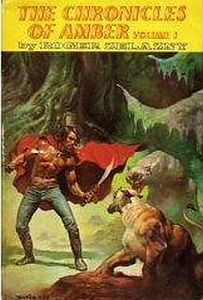
Roger Zelazny, The Chronicles of Amber
Although I read these books awhile after my first early forays into sci-fi and fantasy, The Chronicles of Amber have exerted the second-strongest long-term influence upon me after The Lord of the Rings. Corwin of Amber is probably my all-time favorite fictional protagonist, and the first-person point of view and the gonzo setting of the Amber books simply can't be beat. These books deeply influence how I see magic and multiple dimensions working and interacting -- in fact, certain legendary Lands of Ara NPCs like Morag the Arch-Summoner* exist largely because of how captivating I find the concept of the princes of Amber and Chaos sneaking between dimensions via manipulation of Shadow. It rocks! And Zelazny's imaginative integration of mythical and folkloric beasts into the whole setting is damn memorable too. Hmm, perhaps it's time for a re-read?


Edgar Rice Burroughs, A Princess of Mars etc.
I read ERB's Barsoom books early, like in seventh grade or so, and I really loved them a lot. The world of Barsoom was so evocative for me; I can still see John Carter leaping around on those weird landscapes. Via ERB, I got into the whole science-fantasy mashup genre pretty early, though my D&D / LL campaigns favor an at least superficially Tolkienesque feel and look to them. Yet I nearly always throw a crashed spaceship or some aliens or some inter-dimensional travelers somewhere into my FRPG campaigns, and it's because I have always loved that blending of fantasy and sci-fi found in the Barsoom books (and in Roger Zelazny’s Chronicles of Amber).


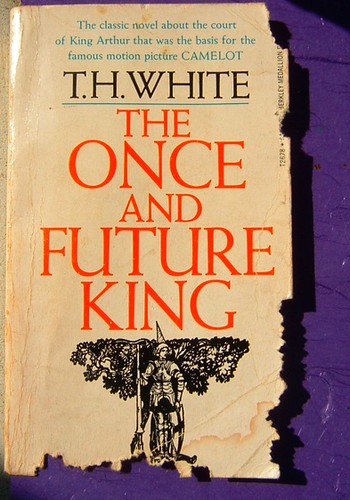
T.H. White, The Once and Future King
Merlin is my third favorite wizard after Tolkien's Gandalf and Monty Python and the Holy Grail's Tim the Enchanter (see next entry). I enjoy Merlin a lot because he is often portrayed as quite Druid-y and pagan, as in The Once and Future King when he turns Arthur into lots of different animals (including an ant!). White's interpretation of the rise and fall of King Arthur is sufficiently epic but primarily human in scale; it is also very funny, as in the sequences involving King Pellinore. But what I like best about this novel, or consider most influential upon my gaming, is its conception of magic: Merlin, Morgan le Fay, and other arcane types in this book (and in the film Excalibur) show us that arcana is nature-based and way more powerful than any single individual's ability to control it. I like that. Magic should never be totally rational nor masterable, and I think I drew that idea largely from Tolkien and White.


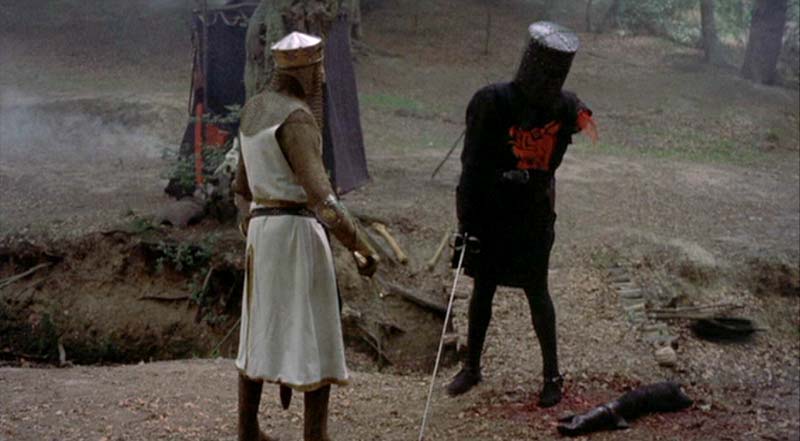
Monty Python and the Holy Grail (1975, dir. Terry Gilliam and Terry Jones)
Like it or not, I love humor in my RPG's. I love grotesque comedy in general, and have been particularly inspired by The Holy Grail's Black Knight fight scene. I love the extreme volume and distance of the blood spurts once the Black Knight starts getting dismembered by King Arthur, and have long attempted to emulate that feel when announcing the combat results in my campaigns: blood and internal organs spurt intensely and far, and a surprisingly large number of blows land in the genitals. As one former player put it, my campaigns seem to take place in a “high-pressure world” where everybody’s blood and internal organs are under a lot of pressure, so as to shoot out really far once pierced in combat. I attribute this trend to Monty Python and the Holy Grail.


Krull (1983, dir. Peter Yates)
Again, Krull's mix of sci-fi and fantasy always worked well for me; this movie was a particular favorite of mine when I was a young lad. It's very D&D ish actually, with its rag-tag party embarking upon a perilous mission across many strange lands. Great stuff! And that magical glaive thingy was bad-ass.


And to conclude, here are a few things I've read lately that I hope will influence my game:


H.P. Lovecraft, The Call of Cthulhu and Other Weird Stories
Please see my review of this volume for more detailed comments, but in short, "HPL's command of written English is nothing short of dazzling. His prose manages to be just rich enough to paint a convincing picture of (creepy) set and (uncanny) setting without stepping over the line into overwrought "purple prose" a la many of Tolkien's descriptive passages or even our own beloved EGG. In short, I find HPL's language to be as evocative as Tolkien's but, at the same time, much more concise."


Lord Dunsany, The King of Elfland's Daughter
I will defer to Cyclopeatron's description: "Style and language. Where fairy tales and dreams intersect. I want stars, moss, and woodsmoke at my table. Dunsany is peerless when it comes to fantasy imagery." Agreed!


P.S. Vance, here I come!

--
* As is briefly mentioned here, Morag the Arch-Summoner is a legendary Arandish wizard who has lived in total secrecy for the past hundred years. He may even be dead or residing permanently in another dimension for all anyone truly knows. Even before his disappearance from human society, Morag was thought to be quite insane. In more recent news, the party in my current Arandish Campaign have found and identified artifacts seemingly related to Morag's cryptic activities.

Friday, October 26, 2012

Non-Linear Dungeon Design Resources

While I am not actively working on a megadungeon project at present, I am still a big fan of dungeon design theory, and have been reading some great posts on the subject of late. Here are just a few of the great resources I've been enjoying:


Was Module B1 a Good Design? This is a post that Spawn of Endra mentioned to me during a recent conversation, then I backtracked and found it on Delta's D&D Hotspot. I think many of Delta's basic assumptions are spot-on, and I would also urge folks to read the comments to the post, especially this one by Justin Alexander, in which he provocatively suggests a new approach to "old-school," minimalistic dungeon location descriptions, saying that:

Minimal keys are great. Minimal keys that primarily focus on creatures and treasure? IMO, you're doing it wrong. [. . .]

I don't think DMs should prep the multi-paragraph litanies of B1, but I'd much rather have a key that said: 

27. A floor of smooth slate and two thrones of white marble. Purple and yellow draperies on the wall.

than:

127. ORC SERGEANT. The leader of the outpost (8 h.p.) with longsword and heavy crossbow.

What an interesting idea! I don't know how extensively I agree with it, but it has me thinking.

Of course, Mr. Alexander has a great deal of credibility, in large part because he is the author of another classic dungeon design post. . .

(Image from Melan's dungeon mapping post.)

Jaquaying the Dungeon. I actually must again thank Delta for reminding me of this great series of posts, though I am a fan of The Alexandrian and have read them before. In them, JA discusses how to "open up" a dungeon (and increase it re-playability value) by providing multiple entrances and exits from each level and locale. An excerpt:

In a jaquayed dungeon, the choices the PCs make will have a meaningful impact on how the adventure plays out, but the actual running of the adventure isn’t more complex as a result. 

On the other hand, the railroad-like quality of the linear dungeon is not its only flaw. It eliminates true exploration (for the same reason that Lewis and Clark were explorers; whereas when I head down I-94 I am merely a driver). It can significantly inhibit the players’ ability to make meaningful strategic choices. It is, frankly speaking, less interesting and less fun.


I always follow these principles when designing modules and highly recommend these posts.

Node-Based Megadungeon Design. Meanwhile, elsewhere in the blogosphere, I bumped into Keith Davies' fascinating posts about Node-based dungeon design, which he may well carry out to a level of complexity beyond my own interests, yet I confess I find the basic idea of Nodes as a dungeon-design starting point compelling. (I also plan to look further into Keith's broader series on Campaign and Scenario Design).

And lastly, it so happens that Justin Alexander has his own series on the Node-based design topic, which I have yet to read. . . .


Please leave a note in the comments if you have other recommendations for good reading on this or related subjects.

"Don't Prep Plots, Prep Situations" -- Justin Alexander

Sunday, October 7, 2012

OSRCon 2012 - Why I Love This Photo

At the end of last year's OSRCon, I wrote a post about a specific photo that really summed up for me all the wonder, adventure, and camaraderie I felt during my first OSRCon experience. I would like to continue the tradition by sharing my single favorite photo from this year's Con and telling you the story behind why I love it so.

Here's the photo:

Chris and me at OSRCon 2012. (Photo by Garfield Noyahr.)

For one, look at the smiles on those two guys' faces. They are having a great time. The guy on the left is named Chris and the guy on the right is me. The shot was taken right at the end of the last session of the Con, mere minutes before we would all disperse and say farewell for another year. Chris and I are sitting at Ken St. Andre's game table, having just played a rollickingly good session of Tunnels and Trolls with the Trollgod himself, and are proudly displaying our T&T 5.5 rulebooks for the camera. Minutes after this photo was snapped, I would ask Ken to sign my copy. He did.

Ken St. Andre with the other Chris - Chris Cunnington, OSRCon coordinator. (Photo by Garfield Noyahr.)

So that's number two: I met Ken St. Andre this year. In addition to playing two different T&T sessions with him, I also got to hang around with him after the Con activities were through -- in fact, we breakfasted together the morning after this shot was taken, and then Spawn and I had the pleasure of driving him back to the airport on our way out of town. Ken is a witty, warm, interesting man and it was a true delight to get to pal around with him for the weekend. Back when I started playing T&T in the early eighties, I would never have believed that now, thirty some-odd years later, I would be gaming and eating breakfast with the game's creator. My weekend with Ken at OSRCon 2012 will always stand as a major highlight of my entire RPG'ing career. 

Thirdly and finally, while this photo at least partially captures these two lads' glee at playing T&T with the Trollgod, it does not fully explain why Chris and I were so enthused. You see, during the session, Chris played an orc who got involved in a shipboard rivalry with another orcish crew member on the riverboat we worked aboard. At one point, Chris decided to teach the other orc a lesson by "accidentally" shoving him overboard and drowning him, and he asked my character -- a human warrior named Hobart the Brave -- to back him up in case he got into trouble. (As I recall, the target of Chris's orc's vengeance had a big orc brother who swore to avenge any foul play visited upon his sibling.) While a bit dubious of Chris' character's motives, Hobart agreed to help his fellow party member, and, when the orc PC's attempt to knock his rival into the river failed -- Chris' character plunged into the water instead -- Hobart leaped into action, faking a stumble and knocking the NPC orc into the river to be killed by Chris' PC. It was awesome, if a little immoral; Chris and I conspired to do something "naughty," i.e., murder an NPC ally, and through teamwork (plus some insanely good die rolling on my part -- best of the session for me) we pulled it off. We laughed quite gleefully after the deed of vengeance was done. I think Ken thought we were bad people after that, but we sure as hell had a great time together.

And that, for me, is what OSRCon is all about: making new allies at the game table with whom to commit somewhat unnecessary acts of violent revenge. Who could ask for more? THANKS CHRIS AND THANKS KEN!

 T&T 7.5 boxed set. (Photo by Chris Cunnington.)

Saturday, September 22, 2012

Starting Campaigns in Established Settings


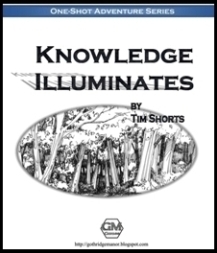
As my contribution to Dice Monkey's September blog carnival, I want to speak briefly about my repeated use of Tim Shorts' excellent  "Starter Adventure" Knowledge Illuminates (published by GM Games) as an inception point for a larger campaign. I have run the adventure twice now, and have found it to be a superb campaign-starter, in part because it avoids the four pitfalls mitigating against good (mega-)dungeon design recently noted by Peter D at Dungeon Fantastic:

1) too much useless backstory
2) slow starts
3) random encounters
4) too many encounters


As I noted in my review of the adventure, "it is the balance the module achieves between keeping it simple -- the scenario itself is quite straightforward -- and offering exciting possibilities for further adventures and/or campaigns" that make it such a valuable and worthwhile gaming product. Since that review was written, I have run the adventure twice, and have found that, just as I predicted, it does indeed give just enough enticing detail to hang custom adventure hooks upon without overburdening the scenario with "useless" or excessive backstory elements. Hence, while KI is NOT a full-blown "campaign setting" in the literal sense of that term, it provides enough of a thumbnail sketch of one to count as an implied setting, especially for an old-school DIY'er. One key feature of the scenario that I do not want to Spoilerize here absolutely sets the world of KI apart (in my mind) from many other settings and implies a great deal about how arcane energies can or might function in any campaign emanating therefrom.


Knowledge Illuminates also avoids the "slow start" problem because it is, on one level, intended as a simple, stand-alone adventure, hence it does not waste time with tons of setting details I would rather fill in myself or in collaboration with my players. The number and types of encounters in the module are pitched very well -- it is well-balanced IMO. I have really enjoyed running it and have found it to be as good a campaign "setting" as any I have ever used.*

--
* To be fair, I must confess that I have never actually used any pre-published "Campaign Setting" unless you count the one sketched and/or implied by what Al Krombach calls "the original adventure path" of TSR modules G1-2-3 and D1-2-3. As I have written before, and similarly to Al, I started out in this hobby playing mostly TSR modules, then moved on to playing exclusively in my own Lands of Ara setting in the 1990s. Hence, maybe I cheated my way around the intent of the Blog Carnival theme -- but isn't that awfully old-school of me?

Thursday, September 20, 2012

Reflections on the Lift Bridge Game and Younger Gamers

In the past I have briefly discussed what it was like to play with younger gamers -- fun! -- and subsequently confessed that despite my interest in playing with members of younger generations, my main mission in reaching out to them as a gamer is to introduce them to the Old Ways, i.e., Labyrinth Lord. Well, I am happy to report that via my Lift Bridge Old-School D&D Group, I am getting my opportunity to do just that.

However, with that mission comes certain responsibilities and special considerations.

My LL Referee's Screen is seeing a lot of good use these days.

Young gamers are fun for me to referee because they really get into the role-playing and the "imagine the hell out of it" spirit that I like to see from players in my games. I always favor players who come up with inventive and entertaining solutions to problems -- like Rolland the cleric assaulting skeletons with his backpack to avoid using a bladed weapon -- rather than the power gamers who just want to "win" at all costs.

However, I faced a tricky situation two sessions ago that, in retrospect, I did not handle very well. Two younger gamers -- not even quite teenagers -- showed up for the public LL game at the bookstore with characters already generated. In fact, their characters were ones they had been campaigning with for some time in a 2e campaign. I was so excited to have them on board, especially given their familiarity (via 2e) with old-school-style play, that I permitted them to use their current characters without vetting said characters very rigorously. Sure, I scaled their PCs down a few experience levels to bring them closer to the party average of about Level 4, but I failed -- until too late -- to realize how many magical items and special abilities they had been granted in their "home" campaign. Not only did these two guys end up having characters who were WAY too overpowered for the party, but I continually had to haggle with them over what powers and items they could and could not use in my campaign. THIS WAS NOT THEIR FAULT -- it was mine. They brought in their PCs and I did not look them over closely enough; otherwise, I could have nipped this in the bud. But I didn't. And after the game, there was some chatter between the older players on the Old-School D&D Group's Facebook page that went a little like this:

PLAYER 1: Should there be an age limit to our group? I've got no prob's with ppl being comfy and having fun. I just feel if there's children in the groups we have to second guess most the game

PLAYER 2: I'm fine with whatever... it only becomes a problem for me when we have to hold back [our adult-themed talk] because of certain people being present who may find it inappropriate. That and when their characters outclass ours. Maybe they should create new characters that fit into our game

PLAYER 3: It's not fun to have to censor yourself. I will say though, I'm totally fine with getting 5k EXP this session.

PLAYER 4: The real tricky part is how do we enforce this now that two kids have joined and we never had any such rule in place before? Anyone know if they're planning on returning?

PLAYER 2: The kids said they wanted to come back but that lady [their mom] seemed hesitant I think.. if they do come back we could just make them create new characters within our game.

PLAYER 4: I was thinking of just not censoring ourselves in hope of turning them away with our matoor language but then I thought about what a monster I was at age 13. Won't work.

PLAYER 2: haha we should anyways

ME: That's the ticket!

PLAYER 1: :) Carter's words should be anuf :p

The two young lads did not return for last weekend's session, though I would not be surprised if they come back sometime in the future. I welcome them but I am attuned to my other players' concerns, especially the power gaming issue. I absolutely plan to make those two re-roll fresh LL characters next time they show up.

As for the blue language issue, that is a quandary. Sure, it is a public game in any case, so I do try to somewhat limit how much I use terms like "the goblin violently sodomizes a corpse" and "you sever his testicles and they roll across the floor, trailing semen" in any case. But gamers will be gamers, and since the majority of the group is in its 20s or older, it may be difficult for us to censor ourselves down to a PG-13 level. We may be able to hit a "soft" R rather than a "hard" R, but that's the most I can hope for I think, at least with this particular crowd. But I know I have a responsibility to set the tone and make all feel welcome.

To our credit, we had a different youngster named Alex show up to the most recent game, and he was a big contributor -- his fighter, Joe, was a heavy hitter in melee and was instrumental in bringing down those skeletal spidergoats -- and I think we were able to say some of our raunchy stuff (I know I used the word "buttocks" a couple of times) without offending his young sensibilities. There is probably a balance to be struck here.

Tuesday, June 12, 2012

Material Components and Radiocarbon Dating

The Spawn of Endra takes a lunchbreak:

There are lots of rules or subsystems or optional McDealios in D&D that might make the game more realistic or increase verisimilitude. Many of those seem kind of cool to me at first glance and then they seem irritating. Many of the mechanics in 1e AD&D fit that bill, which is why I really am a B/X/LL fan at heart. I've noticed that the ones that really get me nowadays are ones where I have some real life experience with the situations they try to account for. So mechanics like "How much damage does a party take in 100 degree F weather?", "Or with no water?" or foraging rules that only include hunting and not gathering plant foods ... or how long does it take to clear a ruin in a jungle ... fuck it. Doing fieldwork I live that shit, and introducing it to the game world in any detail causes me physical and psychic pain.

Material components for spells also sort of irk me, and part of that may be because in my labwork deailing with radiocarbon dating I also have material component requirements. So why do I need that in my game? You see, we use materials of known age as standards when we process charcoal, bone, shells, whatever, so you can account for the 14C background, and to see how well your processing methods work. There's like a sort of alchemists/wizard's council that runs periodic lab intercomparisons and vets data (the IntCal working group). They control the selection and distribution of some of the materials we all use as standards. Actually there's probably some Druids on the council since several of the wood standards (TIRI-B, FIRI-D, FIRI-F) are shavings of a ~5000 BP Irish oak. The super old wood you need to check the background (called a 'blank', colloquially) is >70ka old and comes from a buried log jam on the Olympic Peninsula in WA. All of these come from finite actual pieces of fossil wood, so getting your tiny little vial of it can be difficult. Folks don't want to share.

For bone it's even worse, since most bones are smaller than trees, so sharing this stuff among 10 or 20 labs is less realistic. So for these I've spent a lot of time trying to find good material of different ages, begging for the buried permafrost whale bone to use as a background, trading it for 2000 BP bison tibia I have, exchanging a bit of AD 1880 cow bone from a privy for a Middle Holocene fur seal femur. We have a cabinet full small bits of this stuff that we have to have to run radiocarbon dates. This, plus a bunch of other less unique stuff like silver wire, copper oxide powder, clear fused quartz tubes, acids, bases, hyper-purified water are all the material components of radiocarbon dating. And getting it all and keeping up the networks with other labs so we always have what we need is a sort of constant underlying concern in my work. So the idea of maintaining a supply of bat guano in-game so I can cast fireball is just a bit too close to my real life to be fun.

On the other hand, when we hear someone is going up into the arctic we put in requests for chunks of old wood and mammoth toes, so I can see the possibility of lots of cool hooks for adventures. Maybe I'll ponder that some more.

Friday, June 8, 2012

Dissociated Mechanics and House Rules

I have recently been looking over some archive posts at The Alexandrian, and am most grateful for Justin Alexander's super-smart Primer on Dissociated Mechanics. I highly recommend that post to my readers.

The post sheds light on the underlying reason why D&D 4e didn't really work for me: because as a "method actor" type who loves immersive role-playing, I really cannot bear obtrusive dissociated mechanics. This preference is evident in the primary house rule I impose upon my Labyrinth Lord games: multiple round searching for secret doors. The arbitrary (to me) rule in LL as writ saying that each PC can only search each area once is a dissociated mechanic -- it just doesn't make sense within the role-playing world. It may exist for some very good metagame reason that I don't understand, but it is impossible to justify within the game world, and thus does not support good roleplaying.

In this sense, the "only search each area once" rule in LL-as-writ is quite similar to "healing surges" and "daily powers" in D&D 4e. I have written at length about why 4e doesn't feel right to me, and recently stated at the end of this post that, like Jeff Rients, I do not care at all for healing surges. I noted that this dislike was because these surges make it hard to kill PCs, and indeed, this is partially true. (It's not that I'm out to kill PCs -- in fact, if anything, I am the opposite of a "killer DM" -- but it is just that I want there to be something palpably at stake, I want there to be real danger and threat in the game so that players are forced to play cleverly to secure their own survival.)

But the REAL (or more fundamental) reason I despise healing surges is that they just don't make sense within the roleplaying universe. They represent a dissociated mechanic, unconnected to the character or the game world. So again, thanks to Justin Alexander for making the specific root cause of my system preferences much clearer to me.

Sunday, June 3, 2012

Who's Getting Screwed by 5e?

4e gamers, that's who.

There has been a lot of talk about D&D Next in the blogosphere of late. Now to begin with, I really must emphasize that I have no horse in this race. I have my Labyrinth Lord and I am happy. I have no reason to spend money on a new iteration of D&D regardless of what exactly goes into it. I am NOT a "hater," I am just completely ambivalent about 5e, much as I was about 4e.

Yet with what I can glean from the recent blog posts -- I am not participating in the 5e playtest myself, so all this is secondhand hearsay mind you -- I find myself in the surprising position of feeling a great deal of sympathy for all the 4e devotees out there. Let me explain why.

My basic position is similar to the (much better informed and credible) one recently explicated in an open letter to WotC Labgrrl posted on her blog, UAD&D. (Thanks to David Maccauley for the link to that post.) Labgrrl writes:

"Immediately upon hearing rumors of #DnDNext, a significant number of fans of the current edition began to get confrontational and disheartened in social media. They feel abandoned despite repeated assurances by the WOTC social networking team and even some uninvolved third parties that continued new releases will happen. Their general view seems to be that there is limited point in investment in further books and materials when it’s going to be rendered useless so rapidly.

"The problem with planned obsolescence is that it can create huge feelings of ill-will towards a company [and] when the economy is doing poorly or is in recovery, planned obsolescence backlash increases dramatically."

Labgrrl's comments remind me of a conversation I had with the manager of my FLBS a few days ago. He asked me if D&D changed drastically every time there was an edition change; he seemed particularly interested in the shift between 1e and 2e. While noting that 2e is the one edition of D&D I have never played, so I am not terribly familiar with it, I nevertheless explained to him that, in my view, I didn't see 2e as drastically altering the core rules set forth in the earlier editions. Sure, it added skills and proficiencies, which were either nonexistent or only minimally present in earlier editions, but it did not radically alter the core classes or the main thrust of the rules, as far as I know. In my view, the main changes 2e instituted were to streamline the presentation of the rules, change the dominant style of the artwork, and to santize D&D vis-a-vis its alleged demonic/Satanic content. (Please correct me in the comments if I have this wrong.)

So IF we assume that 0e through 2e were BASICALLY the same system, that's a 26-year run (1974-2000) of more or less completely compatible stuff. Hell, I am even willing to lump 3e/3.5e/Pathfinder in there because despite its major emphasis on skills and feats and hence character "builds," 3e is still ESSENTIALLY a d20 system that hadn't yet introduced player appeasement measures like healing surges, and hadn't severely shifted the game's emphasis from strategy to tactics. So that would give us a 34-year run of more or less compatible systems, before "strikers" and "defenders," the absolute necessity of battle mats, and the near-impossibility of PC death set in in 2008.

Even if we keep 3e/3.5 partitioned off as its own thing, those players (of which I was one for about four years) at least had an eight-year run before 4e was introduced, and after that they had (and still have) Pathfinder and Paizo.

By contrast, the 4e players have had only four years with their edition of choice. And, as far as I know, no guarantee of major corporate support for the edition once it is discontinued by WotC.

Justin Alexander's analysis reveals that 5e's playtest version evinces a strong hearkening back to 3e, and he asks why he would want to play what is essentially WotC's homebrew of 3e when he could just keep playing his own? It's a good question, and I would also ask, if 5e indeed ends up being really close to 3e rules-wise, what will keep the Pathfinder crowd from continuing to play Pathfinder, whose (expensive) rulebooks they already own? This is a recession after all, and sadly it is distinctly possible that "those jobs aren't coming back."

Daniel Proctor supports this view in his commentary, stating that:

"[D&D Next] has to compete with all the other 3.x spinoffs that have been evolving for many years. What can 5e meaningfully add that hasn't already been done? I think that's why D&D 5e feels like an also-ran at this point. The days where the Brand alone was enough are past."

In slightly more concise (and vehement) terms, Biting Halfling over at Tenkar's Tavern called 5e's playtest iteration "a stripped down rebuild of 3rd Edition D&D + exactly four innovations." Again, I cannot confirm these views through my own direct experience of the playtest, nor am I here to judge whether or not 5e will be any good. It's just that it seems like 5e, in returning to WotC's 3e roots, will leave 4e players out in the cold; the 4e crowd -- i.e., WotC's most loyal current customer base -- will be those precisely most screwed by the changes made to bring 5e into closer relationship to the pre-4e editions. This is a strange scenario that may well indicate a kind of limited victory for we old-school gamers, but which also seems to indicate a mild form of corporate schizophrenia on WotC's part, as Labgrrl so eloquently surmises.

Going the way of the Dodo.

Epilogue: My One Gripe
I suppose that while I am here I will add a brief comment about the one thing I do not like the sound of in those secondhand playtest reports: the tendency in 4e and 5e to make it well nigh impossible for PCs to die.

The real threat of character death makes puts something serious at stake, and (in my view) encourages smart play rather than relentless tactical hack-and-slash. The 4e-and-onward editions seem to encourage "low death, low frustration"-style play, as Roger the GS puts it, noting that in 5e "hit points are numerous, the margin of safety for low-level characters is great, and healing remains as available as in 4th edition."

Jeff Rients shares my disdain for this kind of "softening" of D&D, noting that "abstract 'healing surges' are about the most boring game mechanic ever."

More recently, Rients continued his ruminations on this issue, bemoaning the fact that in 4e and 5e "my own personal D&D sweet spot, the hard-scrabble death-at-any- moment fiasco of levels 1-3, is no longer supported. [. . .] For me, all other questions about what should and shouldn't be in the new edition pale in comparison to this simple issue. If by the numbers I can't murder your starting PC with a single lousy orc-stab, I don't want to play."

Patrick Wetmore echoes this concern in his recent post, in which he asks "What kind of delicate flowers have modern D&D players become?"

I totally acknowledge that it's "different strokes for different folks," yet I wonder the same thing Patrick does. Just last week, I introduced about five neophyte gamers to Labyrinth Lord; I started them at 1st Level and ran them through (most of) Tim Shorts' Knowledge Illuminates. During the short (3-hour) session, one PC was killed outright and another reduced to 1 hp. Something was very much at stake for that party; after their elf died, they were much more cautious, and really used that 10-foot pole that somebody thought to buy. I really loved seeing that; a classic D&D situation all the way!

So in the end, I am forced to agree with Dan Proctor, who writes:

"Criticize 3rd edition all you like (and I have), but it was a pretty successful edition. The problem is that when WotC left an edition behind they didn't just revise the game into something else, they torched and salted the fields behind them each time. Each time they tell their customers that there is something fundamentally broken and bad with the previous edition, and in doing so they create a rift between the people who stay behind with the old edition and the people who take the bait for the new edition."

An Afterthought
Was 4e released under the OGL? In other words, could it be retro-cloned?

Thursday, May 3, 2012

Thoughts on a Couple of Ex-Croakers

Here are a couple of RPG'ing products that would have made my bucket list except that I've had a chance to play them in the last year:


- Swords & Wizardry White Box: This is the scrappy little system I used for my first ConstantCon session of Tales from the Hotel Kaladarian. Prior to that single session I had never before played any D&D edition (or retro-clone thereof) prior to 1977, i.e., Holmes. It ran well, though at times I missed the easy familiarity of Labyrinth Lord. In any case, I haven't even come close to playing enough White Box to say that I've given it a fair trial yet.

I am attracted to S&W White Box due to its d6-only weapon damage, d6-only PC hit dice, universal attribute bonuses, no thief class, and "imagine the hell out of it!" ethos. For the purpose of having the rules readily available for all my players to download or obtain, a well-supported retro-clone like Swords and Wizardry is a great bet, much more sensible that trying to play strictly with the original LBBs, IMO.
 

- The Lost City:  I got my chance to run dungeon module B4 by using it as the kickoff module for my local gaming group which started last February. After their first three or four sessions, they found their way to the Underground City, and then the campaign went on hiatus. It will soon start again as I originally intended it, as a public Labyrinth Lord group at my FLBS.

Wednesday, May 2, 2012

Games to Play Before I Croak

A long time ago Beedo posted about the D&D modules he'd like to play before he "finally hangs up the dice for good." My own D&D "bucket list" includes not only modules but also some OSR-ish games I would like to play before my final days. To wit (and in no particular order):


- LotFP Grindhouse Edition: I hope I get to referee or play in an LotFP Grindhouse campaign at some point. Raggi has written a really clear and functional rules set and has added some inventive twists, in particular his Specialist Class, that I would love to road-test. Maybe Spawn of Endra could be persuaded to run LotFP one day?

- The Grinding Gear: Of all the Raggi modules I've seen, this is the one I most want to run a PC group through [see my review here]. Maybe as a one-off, or as a tournament module at some future convention. Maybe it could be done over two consecutive convention sessions.

- The Isle of Dread: Gods, this is the "classic" module I most want to run but never have. That dino on the cover has always appealed to me, as does the module's open-ended "sandboxy" nature. Viva Moldvay!


- Knowledge Illuminates: A strong module with which to kick off a campaign and/or unite a band of adventurers -- perhaps this may be run in my public gaming group in the coming year, or perhaps to start my next Arandish campaign, if the current one ever reaches an ending point. Tim Shorts' fresh, generative module is a terrific wilderness campaign-starter which I've reviewed here.


- Mutant Future: To be fair, I've played this one: I entered the OSR via Mutant Future, playing in Carl's awesome campaign which eventually wrapped up. One day I would like to run a Mutant Future campaign, or at least a few sessions of the game, to see how I like it. I have only played, but have never run, a post-apocalyptic game (outside of Shadowrun, a game I have run in the past but have little interest in playing again), and Mutant Future would probably be my system of choice, unless I get more serious about learning Twilight 2000.

- James Bond 007 or Top Secret: One day I will get around to running a "contemporary" espionage RPG, at least as a one-off or short "single mission" campaign, and it will likely be using one of these two systems.

"Hey Carter, can't we be friends?"

Friday, April 27, 2012

The Village of Hommlet As Adventure Locale

I am a big fan of pilfering ideas, maps, and locales from various published adventure modules and gaming publications. While the Lands of Ara is to some extent a full-fledged game world, with many basic assumptions built in and many others organically accruing over time, it has always also been a place into which I can ungraciously shoehorn a modified map from a Gygax module, a random encounter idea horked from Jeff Rients' blog, and/or an entire megadungeon by Michael Curtis. To me this "sampling" is absolutely integral to my DM'ing process: not only do I enjoy buying, reading, and raiding other creative people's RPG'ing products, but I am also a fairly half-assed and slapdash preparer, so when the PCs suddenly decide to visit a place I haven't yet mapped, it is great fun for me to just choose an old TSR module and use (parts of) that. In short, I like allowing significant input from outside sources, sometimes randomly generated, sometimes deliberately planted, to infuse Ara with elements that exceed the limits of my own imagination.

Along this line, last summer there was a spat of creative blog talk about using TSR's 1979 adventure module, The Village of Hommlet, as a launching point for different types of campaigns. Of course, James Maliszewski has succinctly assessed why Hommlet makes such a rich foundation for old-school adventure in general, but in particular I refer to two separate posts (here and here) on James Smith's previous blog, The Underdark Gazette.*  scottsz in particular gets going in the comments of the first post above with a proposed 'alternate' version of T2, T3, and T4 -- and it rocks! Here are some excerpts:

[Given] how Furyondy and Veluna take such an interest in events of the Temple, characters at 2nd level could take a trip to a garrison to report their findings and make contact with more forces of Good/get more background about the history of the Temple. They might ask an 'official' historian (and not some Hommlet druid) what happened. Perhaps they'll get the truth or another part of a mystery. A full 'city module' isn't required - people of importance would want to prevent any panic about the Temple's resurgence.

If module T2 - Temple of Elemental Evil was targeted for levels 2-4, involved a lot of investigation and 'mood buildup' and led to a Temple visit, PCs still aren't likely to get inside - but at least PCs get there. T2 could culminate in rooting out and nullifying the Greyhawk influence of Temple operatives outside the Temple, even if such influence was to powerful entities in Furyondy or Veluna.

T3 - The Elemental Keys could be about finding (a) particular artifact(s) allowing entrance (perhaps Goldenskull wasn't kept inside the Temple but safeguarded elsewhere!), and wouldn't require railroading if the characters were already (falsely) accused of 'treason' and being hunted.

T4 - The Lady of Fungi begins with entrance to the Temple and reaches Zuggtmoy. Throughout the 'T' series, the assumption is that the 4 classical Greek elements are what are referred to by Elemental Evil - an assumption that proves to be dangerously incorrect!

And then there's James' own proposal to mash-up some of the Hommlet premises / adventure seeds with fungi-based zombies for what he's calling Death Fungi Doom:

I didn't want "T2" to be a megadungeon. I wanted it to be T2, not T2-4 and suitable as a follow-up to T1. Also, T1 is taking place before the Giants/Drow modules, as those events are going to be in play, whether or not the players decide to investigate.

The fungal dead are human corpses whose bodies have been overtaken by a virulent strain of unwholesome fungus. These alien spores animate their non-living hosts into a nightmarish semblance of life and seek to spread the colony into new, recently-deceased corpses.

And of course, instead of a Vampire, down there, we have Zuggtmoy, needing the PC's as much as they're going to need her! And a certain bizarre, keening/humming plant creature, which puts fungi into a stasis, instead of undead. Crypts? Or, maybe thousands of dead combatants, strewn about the dungeon. Put into stasis right before the demonic fungi, was ready to activate their corpses.

Maybe old Zeke has been making forays into the place, taking out bodies one by one and burying them. Unawares, of the quiescent evil, of all that sickening growth. I might need to tweak the timeline, a bit. Maybe decide that St. Cuthbert's followers believe all bodies must be buried. An anti-cremation doctrine might fit well, with old Cugel-dudes historical inspiration.

Now, as an added bonus, I can throw a few scary undead encounters into the dungeon. :)

This all was and is very exciting and inspiring. How fortuitous for me that I ordered module T1 around the same time as these posts (July 2011), and have since had a chance to plant its titular village somewhere in the Lands of Ara.

--
* The Underdark Gazette has been taken down from public view, and therefore my links may not work for you. However, James told me that anybody interested in seeing the old material directly may request access by contacting James via email at dmkastmaria at gmail dot com. See also his current blog, Dreams of Mythic Fantasy.

Tuesday, April 24, 2012

Proto-Domain Level Play in Ara

ckutalik over at Hill Cantons recently made some really smart observations about the implied Domain Game rules to be culled from the class descriptions in the AD&D Player's Handbook, including:

Only clerics, fighters, and magic-users are able to exert political authority enough to be able to squeeze income out of a local population. Furthermore they collect this revenue in varying amounts implying that the classes have different spheres of activity in the realm that [they] can control.

I find this post interesting and timely because in my current Lands of Ara campaign, many party members are creeping up toward levels 6 and 7, i.e., they are approaching name level. Innominus of Endra is the closest -- he just reached Cleric level 7 a few sessions ago. Then, just two sessions after that, the priest of Endra was granted sufficient land and funds with which to begin construction of a Temple to his deity in south Minoch.*

Discussing the role of clerics in domain-level play, ckutalik tells us that the Players Handbook says:

Clerics [. . .] can build a temple and attract followers but not tax [. . .] at 8th level.

At 8th level [clerics] must build “a place of worship, a building of not less than 2,000 square feet in floor area with an altar, shrine, chapel, etc” to attract followers. At 9th level to rule they have the: “option of constructing a religious stronghold. This fortified place must contain a large temple, cathedral, or church of not less than 2500 square feet on the ground floor. It can be a castle, a monastery, an abbey or the like. It must be dedicated to the cleric's deity (or deities). The cost of construction will be only one-half the usual for such a place because of religious help.”

So in terms of the proto-domain game in my current campaign, Innominus is seemingly right on target, possibly even a bit ahead of the curve.

Okay, that covers our cleric. As for magic-users, Hazel (currently MU-4) has announced her extended hiatus from the campaign, so Vivuli is our only contender in this area, and my perception is that he considers himself an assassin first, and an arcanist second. Of domain-level assassins ckutalik writes that:

Like thieves, [assassins] cannot build strongholds but can build guild headquarters when they reach 13th level and defeat the sitting guildmaster “the headquarters...is always within a large town or big city...It is typically a warehouse or other nondescript structure, with safeguards and traps added.”

He adds that:

As [assassins] reach name level they must fight and defeat increasingly smaller circles of high-level characters (and presumably must be fielding the same from NPCs and other PCs) culminating in a single character of the highest level.

If Vivuli decides to foreground his wizardly role more so, he may decide to build a wizard's tower and take a more active role in local/regional rule, but I suspect that his player's proclivities -- and his multi-classing as an assassin -- will prevent this.

Of dwarves we learn that:

Level-caps make [the domain game] a humanocentric part of play for PCs. Only Dwarves with 18 STR [. . .] can become name-level fighters. [. . .] So ruling is really left as far as PCs go to humans.

Obviously, these restrictions do not really apply to my Labyrinth Lord campaign, in which we are using the Dwarf race-as-class. In the LL ruleset, dwarves can reach level 12, and are permitted to create a dwarven stronghold starting at level 9 -- see Labyrinth Lord p. 10.

Furthermore, campaign-setting-wise, the Lands of Ara are a bit less human-o-centric than standard AD&D, at least as things are unfolding in the current campaign. Humans still hold the vast majority of power positions, but our own campaign has seen Yor the Dwarf ascend to a position of considerable political influence in Minoch. This makes sense: dwarves are by far the most numerous and economically influential of the Arandish demi-human races, and Yor is rising to power in a region heavily populated by dwarves -- dwarves who are beginning to act on their desire to challenge the dominant human power structure.

Anyway, I will look forward to more of ckutalik's ruminations on the domain game as my PCs move inexorably toward their own version of it.

--
* Session 54, played 3/11/2012, Session Report yet to be written and posted.

Monday, April 16, 2012

D&D Notebooks on CafePress

Spawn of Endra asked me about the image I included at the end of the last session report:


I explained that this was a scan of the cover of my most recent DM's notebook, into which I take notes on all our ongoing sessions. For a look "under the hood," here is a scan of a recent interior page:


I buy these little journals from CafePress, which has a "dungeons and dragons" themed section. Here is the link to the page with the D&D journals on it, and here is another example of what they've got:


This will probably be the next one I'll get. Click the picture to goto the CafePress site.

Friday, March 30, 2012

It's Official - I Like FUDGE

Last weekend my local gaming group assembled and played a couple introductory scenarios using the FUDGE system.  I was quite impressed with how smoothly and intuitively that system works. I like the notion of "tagging aspects" in order to cause or prohibit certain actions from occurring.  I like the relatively easy mathematics involved.  And, as I have previously mentioned, I really like the dice.


My enjoyable first experience with the FUDGE system inspires me to consider how I might utilize the basic mechanics of FUDGE in an extremely rules-lite kind of way. I don't need it for fantasy RPG'ing -- Labyrinth Lord will do just fine for that, thank you very much -- but maybe I could embark upon a side project (with what time I wonder?) to construct a super-simple FUDGE-based system for quasi-realistic post-apocalyptic gaming a la Twilight 2000.  That is a game/genre I have always wanted to play, and yet I have not been able to wade my way through the Twilight 2013 rules yet -- the book's too thick! I am a busy guy with limited time, so rules simplicity is a must for me.