Showing posts with label DM. Show all posts

Saturday, February 27, 2016

DM Burnout


I have supposedly been running two simultaneous Labyrinth Lord campaigns for several years now. I say "supposedly" because my "home" game (played over Skype) has really been on hiatus for a year or more at this point -- the last two sessions (numbers 87 and 88) took place in June 2015 (on 6/8 and 6/15) and those came after a break lasting since September 2014. I love that group but I cite two factors that led to me losing steam and enforcing, mainly through inaction, a hiatus:

(1) I must admit that gaming over the internet, for me, is a pale shadow of gaming live, in person, at a table. No matter how good the technology gets there is, for me, a disconnect or a missing piece that rears its head in various ways online: less spontaneous fun chatter and humor takes place, some details get missed or talked over or need to be repeated, to somewhat lessened effect. The whole thing feels like a giant, three-dimensional, full-sensory experience being strained through a small, thin, partial, two-dimensional medium. It will do in a pinch but sadly I must report that online RPG'ing has ultimately been a disappointment to me. There are, of course, high points and much fun to be had, but also a lot of tiring pragmatics that drag the experience down for me.

(2) I am experiencing general DM burnout. As evidence of this, just this past weekend I also made official a hiatus for my public Labyrinth Lord game at Lift Bridge Book Shop. The group hadn't met for about a month anyway and "the group" in this case is really down to one guy. Or maybe almost two guys: one player who could show up on time, and another who came for the last hour of each session, unable to come earlier due to his work schedule. Then recently, even guy #1 started missing sessions due to the demands of a new job, so between my feelings of DM burnout and critically low attendance, it was time to give that campaign a rest, at least until summer but maybe indefinitely.


Meanwhile, somebody else I met through the bookstore -- who also happens to be a bookstore employee -- has started running an after-hours 5e game, which I have joined as a player. I am playing Ur, a dwarven barbarian, and having a grand old time fighting undead and the like. I think it is really crucial (at least for me) to take time to see both sides of the referee's screen. Playing in someone else's campaign is really freeing, fun, and rejuvenating. So thanks Christine for running such a great game!

That 5e game has been running a couple of months so far and last weekend we had our first session in which only two players showed up. Prior to that, we were averaging at least three players (in addition to the DM) each time. But never fear, the DM was ready -- she had prepared a short one-off scenario using the old TSR Marvel Super Heroes RPG -- the one that uses the brilliant FASERIP system. (If you love that game as much as I do, check out this site.) I had a great time playing -- who else?  -- Ben Grimm, while my comrade chose Spidey. So fun! It's clobberin' time!

Friday, January 18, 2013

I'm Pro-Fun

Humor in games has been on my mind lately, since Cyclopeatron mentioned it in a comment to this post, and James M. discussed it quasi-recently on Grognardia. Humor is also a core feature of Tunnels and Trolls, which I have been promoting of late. I suppose I have always been a firm proponent of humor in RPG's, largely for pragmatic reasons: I am clownish by nature, favoring comedy over other modes, so I find it constitutionally impossible to resist placing "funny stuff" into the campaign in certain areas.

For example, I love funny names for places (Bull-Licker Terrace, Snotream Harbor) and people (Ox-Head, Fish-Breath). Or, another: I want combat itself to be deadly and for real stakes to exist, yet my descriptions of foe deaths are usually excessive and pretty grotesque and/or scatological, e.g.:

"You slice open his stomach, and his last three half-digested meals spray out onto the floor. As he scrambles around on all fours, screaming in agony as he tries to gather up his spilled intestines, your final blow kills him and he falls to the floor. He flatulates horribly as he expires."

I think the core REASON I enjoy deploying humor into my campaigns is because I actually believe in fun. I want my game sessions to be fun. While I acknowledge the truth and beauty in the ideals set forth by James Raggi in his seminal essay "I Hate Fun," I guess at the end of the day, I am a somewhat lazy, low-genre type of guy and I want my cheap thrills and I want my fun. 


Dunce-face.

Mind you, I am aware that Raggi's post title is meant to be provocative, and that his real argument is not against fun per se but more against players who feel entitled to certain types of comfortable, predictable, non-deadly fun. I am largely in sympathy with Raggi's "anti-fun" position, and by claiming to like fun in my RPG's I am NOT disagreeing with a passage like this one:

"People out there have gotten the idea that if their precious imaginary equipment owned by their precious imaginary man is taken away from them, their fun has been sabotaged!

"The clue phone is ringing, and it’s a collect call for these fun-seekers: YOU’RE NOT SUPPOSED TO LIKE IT. Goddamn, risk and challenge and failure are as much part of role-playing as prancing around like Errol Flynn… er, sorry, Legolas (sorry, wouldn’t want to make a reference that the average modern person wouldn’t know off the top of their head) or something. Shit out there is trying to KILL YOU and there are critters out there that will fuck you up but good if you’re unlucky or not careful.

"What part of, 'The giant spider bites you… oh, you blew your save… roll up a new character!' is supposed to be fun or heroic? Obviously the game was built on a different type of satisfaction."

This is well stated. I too believe in creating a dangerous campaign universe and letting the dice fall as they may and saying FUCK BALANCED ENCOUNTERS. But I also want there to be some levity and laughter and pure, unadulterated fun mixed into my experience at the gaming table. And I don't mean non-diegetic, out-of-game fun like non-gaming-related jokes and the like, which are okay but best kept to a minimum IMO. Rather, I mean IN-GAME-WORLD levity and funny names and comedic weirdness and silly fun. This is a FANTASY world I'm running here, people, and so it can be whatever my players and I wish it to be! In my case, that means a place that is to some extent Monty Pythonesque and silly.

I think most of my players enjoy this humorous style of mine but it may be that some just tolerate it long enough to get back to other more serious and/or exciting parts for them. Overall, my players and I co-create a wide array of gaming experiences at our sessions, including boring ones, and occasionally downright un-fun ones, but also epic ones, and harrowing ones, and brain-teasingly mysterious ones, etc. So it runs the gamut.

But at the end of the day, I am pro-fun.

Monday, January 14, 2013

Carter's Appendix N

FRANK LOVES TO MEET NEW NEIGHBORS!

Inspired by Cyclopeatron, my new Upstate New York NEIGHBOR, I now offer my own Appendix N, which is kind of a deeper rethinking and synthesizing of some ideas I originally posted here and here:


J.R.R. Tolkien, The Hobbit and The Lord of the Rings
As I have confessed before, The Hobbit and the LotR trilogy collectively constitute one of the strongest influences on how I view heroic fantasy and how I referee D&D. The Lands of Ara setting gets its single largest dose of "creative DNA" from Tolkien's Middle Earth. Like many Fantasy RPG'ers, when I picture a hobgoblin, it is The Hobbit’s hobgoblins I see. All of the action around Smaug's Lair -- the thrush knocking, Bilbo's sneaking in, etc. -- is totally iconic for me. And The Fellowship of the Ring's Mines of Moria are pretty much the scariest and most inspiring fantasy adventure locale I've ever read about -- note that Balrogs haunt my campaigns to this day. Thus, while I have always had a bit of gonzo in me -- especially where robots, dinosaurs, and inter-dimensional travel are concerned -- and also run things in a tonally lighter and more comedic vein than Tolkien does, I am forced to admit that The Professor's sense of his world, and the sense of history embodied by the races and setting of Middle-Earth, have been extraordinarily potent influences upon me as a sandbox-constructor.


Roger Zelazny, The Chronicles of Amber
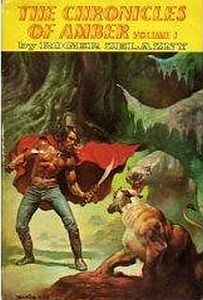
Although I read these books awhile after my first early forays into sci-fi and fantasy, The Chronicles of Amber have exerted the second-strongest long-term influence upon me after The Lord of the Rings. Corwin of Amber is probably my all-time favorite fictional protagonist, and the first-person point of view and the gonzo setting of the Amber books simply can't be beat. These books deeply influence how I see magic and multiple dimensions working and interacting -- in fact, certain legendary Lands of Ara NPCs like Morag the Arch-Summoner* exist largely because of how captivating I find the concept of the princes of Amber and Chaos sneaking between dimensions via manipulation of Shadow. It rocks! And Zelazny's imaginative integration of mythical and folkloric beasts into the whole setting is damn memorable too. Hmm, perhaps it's time for a re-read?


Edgar Rice Burroughs, A Princess of Mars etc.
I read ERB's Barsoom books early, like in seventh grade or so, and I really loved them a lot. The world of Barsoom was so evocative for me; I can still see John Carter leaping around on those weird landscapes. Via ERB, I got into the whole science-fantasy mashup genre pretty early, though my D&D / LL campaigns favor an at least superficially Tolkienesque feel and look to them. Yet I nearly always throw a crashed spaceship or some aliens or some inter-dimensional travelers somewhere into my FRPG campaigns, and it's because I have always loved that blending of fantasy and sci-fi found in the Barsoom books (and in Roger Zelazny’s Chronicles of Amber).


T.H. White, The Once and Future King
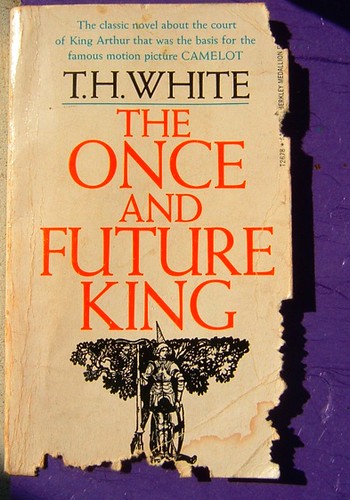
Merlin is my third favorite wizard after Tolkien's Gandalf and Monty Python and the Holy Grail's Tim the Enchanter (see next entry). I enjoy Merlin a lot because he is often portrayed as quite Druid-y and pagan, as in The Once and Future King when he turns Arthur into lots of different animals (including an ant!). White's interpretation of the rise and fall of King Arthur is sufficiently epic but primarily human in scale; it is also very funny, as in the sequences involving King Pellinore. But what I like best about this novel, or consider most influential upon my gaming, is its conception of magic: Merlin, Morgan le Fay, and other arcane types in this book (and in the film Excalibur) show us that arcana is nature-based and way more powerful than any single individual's ability to control it. I like that. Magic should never be totally rational nor masterable, and I think I drew that idea largely from Tolkien and White.


Monty Python and the Holy Grail (1975, dir. Terry Gilliam and Terry Jones)
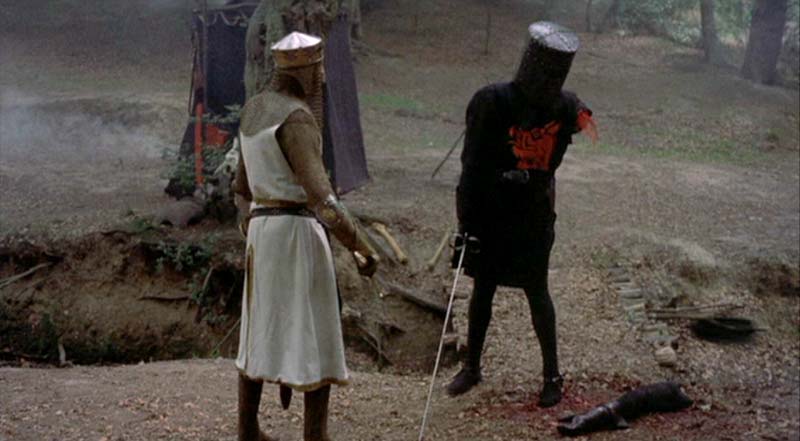
Like it or not, I love humor in my RPG's. I love grotesque comedy in general, and have been particularly inspired by The Holy Grail's Black Knight fight scene. I love the extreme volume and distance of the blood spurts once the Black Knight starts getting dismembered by King Arthur, and have long attempted to emulate that feel when announcing the combat results in my campaigns: blood and internal organs spurt intensely and far, and a surprisingly large number of blows land in the genitals. As one former player put it, my campaigns seem to take place in a “high-pressure world” where everybody’s blood and internal organs are under a lot of pressure, so as to shoot out really far once pierced in combat. I attribute this trend to Monty Python and the Holy Grail.


Krull (1983, dir. Peter Yates)
Again, Krull's mix of sci-fi and fantasy always worked well for me; this movie was a particular favorite of mine when I was a young lad. It's very D&D ish actually, with its rag-tag party embarking upon a perilous mission across many strange lands. Great stuff! And that magical glaive thingy was bad-ass.


And to conclude, here are a few things I've read lately that I hope will influence my game:


H.P. Lovecraft, The Call of Cthulhu and Other Weird Stories
Please see my review of this volume for more detailed comments, but in short, "HPL's command of written English is nothing short of dazzling. His prose manages to be just rich enough to paint a convincing picture of (creepy) set and (uncanny) setting without stepping over the line into overwrought "purple prose" a la many of Tolkien's descriptive passages or even our own beloved EGG. In short, I find HPL's language to be as evocative as Tolkien's but, at the same time, much more concise."


Lord Dunsany, The King of Elfland's Daughter
I will defer to Cyclopeatron's description: "Style and language. Where fairy tales and dreams intersect. I want stars, moss, and woodsmoke at my table. Dunsany is peerless when it comes to fantasy imagery." Agreed!


P.S. Vance, here I come!

--
* As is briefly mentioned here, Morag the Arch-Summoner is a legendary Arandish wizard who has lived in total secrecy for the past hundred years. He may even be dead or residing permanently in another dimension for all anyone truly knows. Even before his disappearance from human society, Morag was thought to be quite insane. In more recent news, the party in my current Arandish Campaign have found and identified artifacts seemingly related to Morag's cryptic activities.

Thursday, October 4, 2012

PK Dick's Indictment of D&D

Does Transcribe the Spawn:

From The Divine Invasion (1981) we have the following for DMs to ponder --

What will become of them now? he asked himself. The people whom he wished to be free. What kind of prison will Belial contrive for them with his endless ability to contrive prisons? Subtle ones and gross ones, prisons within prisons; prisons for the body, and, worse by far, prisons for the mind.

The Cave of Treasures under the Garden: dark and small, without air and without light, without real time and real space -- walls that shrink and, caught tight, minds that shrink. And we have allowed this, Zina and I; we have colluded with the goat-thing to bring this about.

Its release is their constraint, he realized. A paradox; we have given freedom to the builder of dungeons. In our desire to emancipate we have crushed the souls of all the living.


Philip K. Dick

Thursday, September 20, 2012

Reflections on the Lift Bridge Game and Younger Gamers

In the past I have briefly discussed what it was like to play with younger gamers -- fun! -- and subsequently confessed that despite my interest in playing with members of younger generations, my main mission in reaching out to them as a gamer is to introduce them to the Old Ways, i.e., Labyrinth Lord. Well, I am happy to report that via my Lift Bridge Old-School D&D Group, I am getting my opportunity to do just that.

However, with that mission comes certain responsibilities and special considerations.

My LL Referee's Screen is seeing a lot of good use these days.

Young gamers are fun for me to referee because they really get into the role-playing and the "imagine the hell out of it" spirit that I like to see from players in my games. I always favor players who come up with inventive and entertaining solutions to problems -- like Rolland the cleric assaulting skeletons with his backpack to avoid using a bladed weapon -- rather than the power gamers who just want to "win" at all costs.

However, I faced a tricky situation two sessions ago that, in retrospect, I did not handle very well. Two younger gamers -- not even quite teenagers -- showed up for the public LL game at the bookstore with characters already generated. In fact, their characters were ones they had been campaigning with for some time in a 2e campaign. I was so excited to have them on board, especially given their familiarity (via 2e) with old-school-style play, that I permitted them to use their current characters without vetting said characters very rigorously. Sure, I scaled their PCs down a few experience levels to bring them closer to the party average of about Level 4, but I failed -- until too late -- to realize how many magical items and special abilities they had been granted in their "home" campaign. Not only did these two guys end up having characters who were WAY too overpowered for the party, but I continually had to haggle with them over what powers and items they could and could not use in my campaign. THIS WAS NOT THEIR FAULT -- it was mine. They brought in their PCs and I did not look them over closely enough; otherwise, I could have nipped this in the bud. But I didn't. And after the game, there was some chatter between the older players on the Old-School D&D Group's Facebook page that went a little like this:

PLAYER 1: Should there be an age limit to our group? I've got no prob's with ppl being comfy and having fun. I just feel if there's children in the groups we have to second guess most the game

PLAYER 2: I'm fine with whatever... it only becomes a problem for me when we have to hold back [our adult-themed talk] because of certain people being present who may find it inappropriate. That and when their characters outclass ours. Maybe they should create new characters that fit into our game

PLAYER 3: It's not fun to have to censor yourself. I will say though, I'm totally fine with getting 5k EXP this session.

PLAYER 4: The real tricky part is how do we enforce this now that two kids have joined and we never had any such rule in place before? Anyone know if they're planning on returning?

PLAYER 2: The kids said they wanted to come back but that lady [their mom] seemed hesitant I think.. if they do come back we could just make them create new characters within our game.

PLAYER 4: I was thinking of just not censoring ourselves in hope of turning them away with our matoor language but then I thought about what a monster I was at age 13. Won't work.

PLAYER 2: haha we should anyways

ME: That's the ticket!

PLAYER 1: :) Carter's words should be anuf :p

The two young lads did not return for last weekend's session, though I would not be surprised if they come back sometime in the future. I welcome them but I am attuned to my other players' concerns, especially the power gaming issue. I absolutely plan to make those two re-roll fresh LL characters next time they show up.

As for the blue language issue, that is a quandary. Sure, it is a public game in any case, so I do try to somewhat limit how much I use terms like "the goblin violently sodomizes a corpse" and "you sever his testicles and they roll across the floor, trailing semen" in any case. But gamers will be gamers, and since the majority of the group is in its 20s or older, it may be difficult for us to censor ourselves down to a PG-13 level. We may be able to hit a "soft" R rather than a "hard" R, but that's the most I can hope for I think, at least with this particular crowd. But I know I have a responsibility to set the tone and make all feel welcome.

To our credit, we had a different youngster named Alex show up to the most recent game, and he was a big contributor -- his fighter, Joe, was a heavy hitter in melee and was instrumental in bringing down those skeletal spidergoats -- and I think we were able to say some of our raunchy stuff (I know I used the word "buttocks" a couple of times) without offending his young sensibilities. There is probably a balance to be struck here.

Monday, April 16, 2012

D&D Notebooks on CafePress

Spawn of Endra asked me about the image I included at the end of the last session report:


I explained that this was a scan of the cover of my most recent DM's notebook, into which I take notes on all our ongoing sessions. For a look "under the hood," here is a scan of a recent interior page:


I buy these little journals from CafePress, which has a "dungeons and dragons" themed section. Here is the link to the page with the D&D journals on it, and here is another example of what they've got:


This will probably be the next one I'll get. Click the picture to goto the CafePress site.

Saturday, October 8, 2011

Answering Jeff Rients' Twenty Questions (Part 2 of 2)

This post is part two of a two-part series in which I attempt to answer Jeff Rients' list of "Twenty Quick Questions for your Campaign Setting." My first ten answers are here, and Jeff's answers about Wessex are available here and here.

So here is Part 2 of "Twenty Quick Questions for The Lands of Ara":


11. Where can I hire mercenaries?
Almost anywhere in the areas right around the Bay of Noffel -- i.e., the Free City of Kaladar, the Noffellian port towns of River's End, Silverhilt, and Jakama, and/or the Blintian bayside metropolis of Blintsport. In the north, your best bet is Tradefair or Ironcrown, though a certain number of B-grade mercs and swamp-lurking types are probably available in Swampsedge.

12. Is there any place on the map where swords are illegal, magic is outlawed or any other notable hassles from Johnny Law?
Arcane magic is outlawed in Noffel, upon punishment of exile (for the most minor infractions) or death (for everything else). And in general, as far as law enforcement goes, the Noffellian High Guard, the Kaladarian Royal Guard, and the Telengardian Roughriders are the most feared, manichean organizations in the Lands.

13. Which way to the nearest tavern?
I have blogged about this before, but now, thanks to the travels of my current PC party, I can happily add a few more entries to the list of Noteworthy Inns and Taverns of Ara. Here are some key establishments the PCs in my current campaign have visited during their adventures so far:

in Fortinbras
- The Drunken Yeti, the local adventurer's bar
- The King Hargon Inn, a reputable dwarven inn

in Farn Junction
- The Lazy Basilisk, an adventurer's bar
- The Stone Mountain Inn, a dwarven establishment

in the Free City of Kaladar
- The Orc's Balls Inn, a somewhat seedy establishment near the South Gate
- The Greedy Lion, in the North Wall District

In general, it is not difficult to find a drinking establishment anywhere in Ara, though many Noffellians tend to be restrained drinkers or even teetotalers, as are some fairly extreme Telengardians.

14. What monsters are terrorizing the countryside sufficiently that if I kill them I will become famous?
There is always Krakko the Iron Drake, who is so notoriously hated and feared that his death and killer would be celebrated forever throughout the Lands of Ara and beyond.  More realistically, there is a greatly feared red dragon named Razgar who terrorizes northern Ara, a rumored Troll-King in the wildlands down south of Mizar, and many notorious hobgoblin tribes in the northeastern dwarven lands and in the central Minochian mountains.  Lately, there seem to be a great many black dragons terrorizing central and southern Ara as well. And lastly, in the region of the Great Western Swamp, anyone who could exterminate a sufficient number of swamp trolls so as to reduce their deleterious impact on towns like Swampsedge and Sluggerton would be thanked, rewarded, and revered in that region for years to come.

15. Are there any wars brewing I could go fight?
Yes, the so-called New War between Delzar and Mizar, which is really just a long, drawn out border dispute, but no less violent or bloody for it: a great many Mizarian, Delzarian, and mercenary lives are lost to this longstanding conflict every day.  At the opposite corner of the map, there are (rumored) skirmishes between elven and rodian forces taking place in the far northwest, near the western Arandish sea coast on the city of New Port. And of course, there is constant territorial infighting in many places throughout the Western Lands.


16. How about gladiatorial arenas complete with hard-won glory and fabulous cash prizes?
Arenas and gladiatorial battles (to the death anyway) are considered somewhat uncivilized in southern Ara, though there is a famous old arena in Highgate, nowadays only used for ceremonial purposes. However, there is a thriving gladiatorial circuit in the Western Lands and parts of Telengard: Ironcrown, Tradefair, and even Swampsedge all contain active gladiatorial competitions.

17. Are there any secret societies with sinister agendas I could join and/or fight?
The most noteworthy (or notorious) of these would include: (1) the Red Hand, a super-secret assassins' guild supposedly based in Kaladar, (2) the Invisible Hand, a secret society of powerful wizards who resist Arandish law, refusing to join the Council of Arlon, and (3) various dragon cultists, the most terrifying and evil of these latter groups being the one that worships the aforementioned Krakko. 

18. What is there to eat around here?
This is the hardest one to answer, and it varies regionally.  The lands immediately surrounding the Bay of Noffel, i.e., Noffel and Blint, serve a lot of fish and seafood; Blintian mussels are treasured throughout southern Ara.  Minochians herd a lot of goats, but also grow various vegetable and grain crops in the areas east of the high mountains.  The most lush farm- and grazing lands in Ara are in central Achelon and throughout Delzar, so practically any edible crop or form of livestock may be consumed in those Lands or in the Free City of Kaladar.  Despite monster incursions, sheep are raised in many areas of northern Ara and the Western Lands.  Telengard, consisting largely of blighted lands, depends upon local goat-herding as well as imported grain, fungi, and meat from the northeastern dwarves for its sustenance.  Mizarians occasionally herd cattle, and when they do the meat produced is the finest in the Lands, but they mostly prefer to hunt large land mammals (tigers, oliphants, etc.) that roam the southern plains.  And lastly, there have occasionally been unusual fruits and meats brought back by explorers of the southwestern Komar Peninsula, but none of these exotic offerings has yet taken a firm or consistent place in the culinary traditions of the Lands of Ara.

19. Any legendary lost treasures I could be looking for?
Yes, The Crimson Blades.


20. Where is the nearest dragon or other monster with Type H treasure?
Well, converting that "Type H" B/X / AD&D designation into a Labyrinth Lord Hoard Class using my handy-dandy Treasure Type Converter, I see that this query refers to creatures of Hoard Class XV, i.e., dragons and dragon turtles but not much else.  So I would refer you to item 14 above, which is mostly a list of dragons anyway.

Sunday, October 2, 2011

Answering Jeff Rients' Twenty Questions (Part 1 of 2)

Awhile back, Jeff Rients posted a list of "Twenty Quick Questions for your Campaign Setting," which he then proceeded to answer (here and here) for his own Wessex campaign. Inspired by his example, I will now answer those same twenty questions as they relate to the Lands of Ara, to the best of my ability, also in two parts. Here goes part 1:

1. What is the deal with my cleric's religion?
We are discovering that as we play. Some well-known and widely worshipped Arandish deities include Awra, the creator-sorceress; Frey, God of the Noffellians; and Aldor, goddess of the Elves. Innominus, my current PC group's cleric, has suggested that his own order, the Followers of Endra, are a smaller sect, possibly based in the Western Lands, but who (like all other religious groups in Ara) also have a Temple in the Free City of Kaladar. In general, as I have previously posted, "Adventurers in Ara can surely find temples to almost any god or worshippable thing within the walls of the Free City of Kaladar; but outside that city, full-blown temples to anything besides local deities or those entities specifically designated below are probably rare."


2. Where can we go to buy standard equipment?
Any small- to mid-sized town* in civilized areas of Ara would do.

3. Where can we go to get platemail custom fitted for this monster I just befriended?
The Free City of Kaladar. Maybe a few skilled armorers exist in towns with significant dwarven populations like Farn Junction or Ironcrown who could pull off such a task as well.  Of course, no civilized Arandish town or village would allow you to bring your new monster acquaintance inside its walls!


4. Who is the mightiest wizard in the land?
The greatest living thaumaturgist in the Lands of Ara is Arlanni, current head of the White Council of Arlon. However, many Arandish folk believe that Awra herself still roams the Lands, sometimes in Gold Dragon form, sometimes as a human, even occasionally as a rodian. If these legends are in any way true, then the creator-sorceress would rank highest -- for she could surely blow Arlanni out of his booties any day of the week.

5. Who is the greatest warrior in the land?
Officially, whoever is the King of Noffel's current Champion and Captain of the Noffellian High Guard. But that would be a highly contested title, especially outside southern Ara. Usually the head of the Kaladarian Royal Guard is a major badass as well, and there may be other less well-known warriors toiling away in the monster-infested regions of northern Ara who have not been given their due in more civilized circles.

6. Who is the richest person in the land?
I am not completely sure, but I know that he or she surely lives in the Free City of Kaladar. Or possibly is a member of one of the older Noffellian families, or is an Achelonian noble in the Queen's favor who possesses vast tracts of central Arandish land.

7. Where can we go to get some magical healing?
Temples of the Healers of Carcoon abound in most central and southern Arandish towns and cities. Other local and regional sects may offer this service as well.


8. Where can we go to get cures for the following conditions: poison, disease, curse, level drain, lycanthropy, polymorph, alignment change, death, undeath?
The Brothers of Carcoon could do most of these things, but only in their Temples in towns at least the size of Farn Junction, i.e., Medium Towns or bigger (pop. 4,500+).*

9. Is there a magic guild my MU belongs to or that I can join in order to get more spells?
Yes, it's called the White Council of Arlon, and you MUST join it upon reaching name level, or else be hunted down by its (powerful) representatives.

10. Where can I find an alchemist, sage or other expert NPC?
Many good-sized towns in Ara may have such experts, but the larger the metropolis, the better. The Free City of Kaladar is a sure bet, as would be Highgate, the Noffellian capitol. The Delzarian capitol of Bilnhof is also well-known for its high concentration of sages and folklorists.

More Arandish secrets will be revealed in Part 2!
--
* See Labyrinth Lord p. 125 for settlement size categories.

Monday, September 5, 2011

Mobile DM'ing Equipment - Dice

With my public FLBS Labyrinth Lord game getting started soon, it strikes me that I may need to invest in a few more dice than I currently own.  I recently revealed how many dice I possess, and it is not really a giant collection: 

 
What I have now is enough for myself and a few players, but maybe not quite enough to go around if I get a large number of dice-less neophytes arriving at my gaming table later this month. 

When it comes to new die purchasing, I immediately think of Chessex Dice. Look, for example, at these:


Or these:


Or perhaps it is finally GameScience time.  I have read the posts about their quality and accuracy, and I am intrigued by some of the "oddball" selections like the d7 and the d5.  Yet for my present purposes -- bulking out the collection for general, public use -- maybe Chessex is the way to go?

Any comments?

P.S. Note to self: I should also look up where the local game / hobby shop is in the Rochester, NY area, so maybe I can buy these dice from a FLGS.

Thursday, September 1, 2011

Mobile DM'ing Equipment - Minis vs. Card Tokens

Image copyright 2011 by Kelvin Green


I got some great comments on my recent post about possibly investing in minis for Con / public game play. One of the ideas that got suggested was that rather than going for 3D minis at all, I could simply use card tokens (like that pictured above) on my new battle mat instead.

There do seem to be a number of advantages in going this route:

- card tokens are surely cheaper than 3D minis, yes?

- card tokens travel easily and take up far less space than minis

- Kelvin has some here for free download

- At least in theory, one could prevail upon (or literally hire out) artists from the OSR blogosphere (Hi Kelvin!) to create custom tokens for specific monsters and PC types (e.g., rodians) one needs

Is this line of thinking blasphemy, as Christian suggests?

As a counterpoint, here is EGG on the subject of minis:

USE OF MINIATURE FIGURES WITH THE GAME

The special figures cast for ADVANCED DUNGEONS & DRAGONS add color to play and make refereeing far easier. Each player might be required to furnish painted figures representing his or her player character and all henchmen and/or hirelings included in the game session. Such distinctively painted figures enable you to immediately recognize each individual involved. Figures can be placed so as to show their order of march, i.e., which characters are in the lead, which are in the middle, and which are bringing up the rear. Furthermore, players are more readily able to visualize their array and plan actions while seeing the reason for your restrictions on their actions. Monster figures are likewise most helpful, as many things become instantly apparent when a party is arrayed and their monster opponent(s) placed. Furnishing such monsters is probably best undertaken as a joint effort, the whole group contributing towards the purchase of such figurines on a regular basis. Be very careful to purchase castings which are in scale! Out of scale monsters are virtually worthless in many cases. As a rule of thumb, HO scale is 25 mm = 1 actual inch = 6’ in scale height or length or breadth.

Figure bases are necessarily broad in order to assure that the figures will stand in the proper position and not constantly be falling over. Because of this, it is usually necessary to use a ground scale twice that of the actual scale for HO, and squares of about 1 actual inch per side are suggested. Each ground scale inch can then be used to equal 3% linear feet, so a 10’ wide scale corridor is 3 actual inches in width and shown as 3 separate squares. This allows depiction of the typical array of three figures abreast, and also enables easy handling of such figures when they are moved. While you may not find it convenient to actually use such figures and floor plans to handle routine dungeon movement, having sheets of squares for encounter area depiction will probably be quite helpful. If you do so, be certain to remember that ground scale differs from figure scale, and when dealing with length, two man-sized figures per square is quite possible, as the space is actually 6 scale feet with respect to length. This is meaningful when attacking a snake, dragon, etc. if characters are able to attack the creature’s body length. With respect to basically bipedal, erect opponents, scale will not be a factor.

Details of preparation and painting of miniature figures for the game are not germane to this work. Your hobby supplier will have an assortment of small brushes and paints for such purposes, and you may inquire there as to the best techniques of painting.


Dungeon Master's Guide pp. 10-11

Any thoughts anyone?

Sunday, August 28, 2011

Mobile DM'ing Equipment - Combat Mat

Now that I have DM'ed my first Con game, I find myself thinking about my equipment needs a bit differently. For example, in the olden days (the 1990s), I used to use a huge, classroom-sized white board for drawing maps and diagramming complex tactical encounters for my home RPG'ing group. Now that I DM exclusively from Skype, I don't do that anymore -- my big whiteboard is down in the garage.


For OSRCon, I acquired a mini-whiteboard, and it worked really well during Con play for quickly drawing a room layout or diagramming a combat scenario.


But then I got back from Toronto and saw the above picture of James Maliszeski's Crystal Caste "combat mat" and then read this comment where he tells exactly where to buy it [and more recently, some other folks have jumped on the trend].  I got really inspired by this, for I realized that a flexible mat like that would be great for on-the-road DM'ing, and it even has gridlines and hexes on alternate sides to boot.  So now, thirty bucks (with shipping) later, I have a flexible combat mat on its way to my house.  

Oddly, at the time I ordered the mat, the revelation I share in the next paragraph literally did not occur to me at all.  It was not until after I ordered the mat and reflected upon my consumerist victory that this related idea emerged and I realized (too late!) that I may have inadvertently taken a step toward creating a huge monster.

For the purchase of this combat mat inevitably leads me to the topic of miniatures, an aspect of our beloved hobby with which I have never directly engaged.  Yes, you read that right, I have never owned nor painted a single miniature.  I have gamed a small handful of times using them, but only when someone else brought them along.  I don't dislike using them if they're on hand; I have just never felt the need to actively seek them out.  I have an ambivalent relationship with fantasy miniatures.

But now I have that damn battle mat coming, and there's also this recent news about a line of miniatures being released specifically to complement Labyrinth Lord. I have to admit, that second set of soon-to-be-released minis shown here, the "Level Two Monsters" box, looks kind of badassed:

Includes 3 Gnolls, 3 Ghouls, 3 Zombies, 4 Troglodytes, 2 Shadows, 3 Large Crab Spiders, 3 Berserkers, 1 Green Slime, 1 Yellow Mold and an Evil Magic-User.

So should I invest in a few minis (for practical purposes if nothing else) since I have already thrown down for the combat mat?  Or is this how a horrible obsession starts?  It just seems like having a few minis to accompany the mat would make a smart combination of practical materials for quickly sorting out combat situations at Cons and the like, when (real-world) time is a factor. 

I think the biggest down side to my collecting any minis at all is that I have no interest in painting them.  Sitting around painting minis does not (at this juncture) strike me as much of a good time.  But then again, once you buy them, have you not taken that critical first step toward the dark side? 

Monday, August 22, 2011

Answering Beedo's Challenge

Here is my contribution to the "Three Best DM'ing Practices and How They Work" challenge instigated by Beedo via Hill Cantons:

1. Name three “best practices” you possess as a GM. What techniques do you think you excel at?
2. What makes those techniques work? Why do they “pop”?
3. How do you do it? What are the tricks you use? What replicable, nuts-and-bolts tips can you share?


1. Play a ruleset you like.
I really don't want this to become a bitch session about rules preferences or an incitement to edition disputes, but I do believe that each DM should run games using a rules system that s/he is comfortable with and that s/he likes. My all-time worst DM'ing experiences were the result of ruleset mismatch; I was trying so hard to accommodate my players that I ruined the fun for myself. Since as DM you are the main person interfacing with the rules, you get to pick the rules. And you should always pick rules that inspire your imagination and get your juices flowing. If that means a lot of houseruling, so be it. Much as I think rules should "disappear" once the game gets going, that will only happen if the DM is super-comfortable with the rules and rulings s/he's chosen.

How to fulfill this practically? (1) Buy and/or download as many different rulesets as grab your attention and/or interest you. (2) Read them. (3) See how reading them makes you feel. Full of adventure ideas and far-reaching campaign possibilities? It's a keeper. Bored, off-put, overwhelmed? Don't bother.

Here's links to a few (free) starting points:

Labyrinth Lord
Labyrinth Lord Advanced Edition Companion
Swords and Wizardry White Box
Swords and Wizardry Core Rules
Lamentations of the Flame Princess "Rules and Magic"

2. Set the tone.
This one sounds ephemeral but I think it is incredibly crucial, not to be overlooked. As DM, you have an immense amount of control over the tone and vibe that exists at your game table. You are the one person everyone else defers to and looks up to for guidance, not just for rulings and world-description, but for everything. You are the boss of the table, and in that sense you serve as a de facto host of the gaming event, even when it does not take place in your own home or space. Therefore you need to be welcoming, inclusive, and, well, fun. Sure, you want to be able to spook your players at times and to always keep them on their toes, and those things require some restraint and a good poker face, but you cannot play things too seriously or be too subdued, or else no one else will feel comfortable acting zanily or bringing their full energy and gusto for adventure to the table.

My practical recommendation for this one relates to NPCs: play every one to the hilt.  Or, as David recommends in his second piece of DM'ing wisdom, "Ham it up." That's what Elminster would do! Even if you tend more toward the non-actor side, remember that your NPCs are the main vehicle (outside of location descriptions) through which you convey the feel of your game-world to your players. I would probably argue that, outside of the amazing things that occur due to direct player action, well-crafted and -acted NPCs provide some of the most memorable moments in an adventure or campaign. So my advice is to attempt to shed some of your inhibitions and "ham it up" a little.

3. Keep die rolling (and math) simple.
I know this one will put off the math-heads and crunch-lovers, but I was really inspired by something Ed Greenwood said at OSRCon: that the reason we're all here is to role-play, not rule-play. I like that way of putting it because while it does not dismiss the existence or importance of rules, it emphasizes that the real essence of what makes our hobby special is the synergy that takes place when everybody is there immersed in the game-world during a session.

One way I have been working to simplify die-rolling on my side of the screen is to fall back on two or three simple die mechanics that become my "default" or "go-to" dice when some unexpected event arises. In my case, the die I overwhelmingly reach for above any other is the single, trusty 1d6. With few exceptions, my rolls for on-the-fly occurrences and snap rulings are all made with the single six-sider. I think to myself, "okay, this has an x in 6 chance of happening" and then I go for it.


Another event resolution mechanic I use in a wide array of situations these days is the "Reaction Roll," a 2d6-based system originally intended for hiring retainers (see Labyrinth Lord p. 46). I use that mechanic/table for almost any situation where negotiating, haggling, bluffing, or persuading is called for and where the result is not immediately clear strictly from roleplaying it out. For example, if the PCs want to haggle with some unfriendly goblins, and yet after what the speaking PC says I am unsure whether or not the goblins will go for it, I roll a 2d6 reaction roll, factoring in the parlaying PC's Charisma bonus and adding or subtracting from the roll based upon the roleplaying dimension (i.e., what s/he actually says) as well. This has been working really efficiently for me, and is a good "go-to" for a guy DM'ing a group who likes to negotiate and bullshit their way out of a great many in-game situations.

So I guess my recommendations largely center on finding ways to make the rules disappear during game play so that role-playing can fluidly occur.  Those are the types of games I like to run and play in, so as DM I always try to create conditions that encourage and facilitate those outcomes.

Fight On!

Sunday, August 21, 2011

d20 vs. 3d6 Attribute Checks

Hey math-heads! Maybe you can help me figure out what the difference is between attribute checks rolled using 1d20 as opposed to those rolled with 3d6. I can figure out the first part since the d20 provides a linear probability curve.*

For example, if I have a 14 strength, pretty good, and have to roll 14 or under on a d20, that's 14 chances in 20, or a 70% chance of success.

If I am a weak little fellow with a STR of 6, my 6 chances in 20 = 30% success rate.

STR 11 = 55% success rate on a d20 attribute check, and STR 18 = 90% success rate on a d20 attribute check.

Got it.  Pretty reasonable-seeming mechanic.

But while I understand the concept of the bell curve and know that the results of several 3d6 rolls average out toward the middle of the range over successive rolls, I cannot quite conceive how that impacts the chances for a STR 18 attribute check vs. a STR 11 attribute check. Here is Gygax's table:


Am I correct to interpret this as meaning that a STR 11 fighter has a 13% success rate on a 3d6 attribute check, and that a STR 18 fighter has a 1% success rate?  I love d6-based mechanics like 2d6 Thievery and 2d6 Bardery but this 3d6 vs. d20 attribute check thing seems kind of extreme -- like a 3d6 attribute check mechanic would be way unfair to characters with attributes in the 12-18 range.  

Right?

--
* I'm no mathematician -- I stole everything I know about how dice generate probabilities from EGG's discussion of the topic on pp. 9-10 of the Dungeon Master's Guide.

Wednesday, August 17, 2011

Me and Orson Welles

No, my post's title does not refer to the Richard Linklater film of the same name, although I have been planning to check out that picture in the near future.  Rather, I intend to briefly comment on an actual parallel that exists between Welles as a theater director and myself as a DM.


You see, I am currently reading Simon Callow's superbly written biography of Orson Welles, The Road to Xanadu, and am at the point in the mid-1930s when Welles (working with producer John Houseman) is making his first significant mark on the American theater scene with his all-black-cast adaptation of Macbeth.  Callow writes of Welles that:

"He was not, in fact, a great innovator at all; he was a great fulfiller.  Pragmatic rather than visionary, he was supreme as a doer."  (p. 242)

I think this aptly describes me (and perhaps many others) as a DM: a cobbler together of ideas, a hybridizer, a fulfiller.  I like that word.  Because while I am in awe of innovators and folks who can think "outside the box," what seems to matter most at the game table (or at least my game table) is an ability to flex with what you are given, to mix and match elements borrowed from anywhere, and to pragmatically address the narrative and game needs of the players and NPCs as they arise.  True innovation can be quite inspirational, and innovative ideas often provide the fodder that we doers work with, but at the end of the day, I am not ashamed to stand with Welles as a workmanlike borrower and weaver of other people's innovations. 

Wednesday, June 22, 2011

My FLBS Game's Promotional Blurb - Help!

Today I met with the owner and (subsequently) the manager of my FLBS*, Lift Bridge Books. Wow! Such pleasant and welcoming fellows. Both gentlemen were totally open to my running Old-School D&D games in the store on a once-a-month (or even every-other-week) basis.

Joe, the manager, helped me nail down some specifics. We decided that Sunday would be the best day of the week to hold the sessions, since the store closes at 8pm weeknights (a bit early if we presume a post-dinner or after-work start time) and Saturdays are already booked up with other public events. The store's regular Sunday hours are noon-5pm, so we figured 1pm Sundays would be a good start time -- that gives the group up to four hours per session if we want to game that long.

[As a reference, my "home" gaming group meets for four-hour sessions every other week, which works really well for us. We will see if the locals who attend the public FLBS game are as gung-ho as my private group.]

Joe and I agreed that the first step should be to hold an organizational / orientation meeting, to see what the interest level is like. We went ahead and set the date for that initial meeting: Sunday September 18 at 1pm.

Thus it begins.

In a move emblematic of how gracious and helpful Joe was throughout today's process, he volunteered to post an announcement of the first meeting on the store's website ASAP, and said he would also post flyers around the store and at the coffee shop across the street.

[Interestingly, Joe told me that my visit today wasn't the first time an attempt had been made to lure a regular RPG'ing group into the store. A couple years back, Joe was approached by a then-active D&D group from the nearby College, but negotiations eventually fizzled.]

Anyway, my immediate task is to compose a brief blurb for the bookstore's website, in order to give prospective attendees a flavor for what is to come. My goal is to write something that is welcoming to the general public (i.e., embracing players of all ages and degrees of RPG'ing experience) and makes clear that we are playing Old-School Basic D&D (i.e., Labyrinth Lord), NOT 4e- or Pathfinder-style D&D.**

This is what I have so far -- remember that I am trying to keep it short:

Play the Basic Dungeons and Dragons tabletop role-playing game as it was played back in 1981! Very easy to learn and great fun to play. All ages and skill levels are welcome.

Any suggestions? How can I make this as succinct, welcoming, clear, and FUN-sounding as possible?

--
* Favorite Local Book Store.
** As I made clear to Joe, my foregrounding of the Old-School nature of the group is NOT about promoting Edition wars but is meant to avoid disappointing those who might otherwise expect 4e as a default. Since this is a public game, I plan on being the consummate pro as a DM and host, and will keep my anti-4e opinions to myself, especially since the store does sell 4e products.
On a quasi-related note, Joe revealed to me that the store's sales of RPG products noticeably tapered off during the 3.5e period. Joe is not an RPG'er himself and has no horse in the race, but he nevertheless posited that the expense of the books and the rapidity of Edition changes (3e to 3.5e, then 3.5e to 4e) had turned off buyers. I found that observation interesting.

Thursday, June 2, 2011

Strategic Control, Tactical Chaos

It is possible that I share with many DM's a penchant for slight control-freakishness, especially at the strategic or world-building level. Like most DM's, I like to create a big container (a "sandbox") in which others may come and play. While I am extremely flexible about what goes on at the tactical level -- I like chaos, surprises, and lack of control in the heat of the game session -- I nevertheless like to be the "holder of the container" for the gaming group as a whole. I enjoy providing the base content for the game-world, I enjoy refereeing, and I enjoy setting a general vibe which provides context for the group's interactions.

I mention this because in the wake of my confession yesterday that I am having doubts about hijacking that local teen-oriented 4e group in the name of Labyrinth Lord, I have realized that there is more to it than simply a resistance to playing 4e. In fact, there is an even more important reason why I am wavering from my original plan to convert that group to the Old Ways: because there is another, more appealing public gaming venue opening itself to me.

I mentioned a month or so ago that I have been in dialogue with a staff member at my town's local bookstore about possibly hosting some monthly LL games there. Every indication is that the owners are into it -- they host multiple reading groups and community activities there already -- and I admit that I am much more excited to start something from scratch than I am to convert the preexisting teen group to my will. Why?

1. The teen group meets way too often, i.e., weekly. My preferred meeting frequency for the public LL group would be monthly, or, at most, semi-weekly. Starting a new thing at the bookstore would allow me to set up the schedule to best suit my needs and capabilities.

2. The world-builder / container-holder in me likes the idea of a blank slate. At the bookstore, I can create my own announcement and flyer and set the proper tone for the group from the get-go. I could advertise the group specifically as an old-school gaming group, and might hopefully obtain support materials (Posters? Retail editions of the LL rulebook to stock in the store?) via my official participation in the Labyrinth Lord Demo Team.

Is it greedy of me to want my own "virgin" territory in which to set up my first open-to-the-public gaming group? Might I be screwing up those teenaged kids' souls forever by abandoning them to D&D IV?

Obviously I melodramatize a bit here: that group seemed perfectly happy playing 4e.

And I feel myself more strongly drawn toward initiating my own LL-based setup at the book shop in September.

So there's the second reason for my waning interest in the extant D&D IV group, and here is my Joesky payment:

Globe of Immersion
This powerful magical item looks like a perfectly spherical, 9" diameter, light-blue crystal. It is surprisingly weightless given its size and its hard, crystalline surface -- it is as if the object were hollow. The Globe of Immersion may be thrown at a single sentient target up to 20' away; when so thrown, it flies toward the target at lightning speed, completely surrounding the target's head (or whatever portion of its body contains its brain and/or eyes). The Globe shrinks to fit small heads and expands to fit big ones. After affixing itself around the target's head, the Globe causes the target to believe that he/she/it has been teleported to whatever location/plane/world the Globe's user describes. In reality, the affected creature is still in the same physical place as before, but under the spell of a powerful full-sensory hallucination. Nothing short of disabling the Globe via Dispel Magic will permit the target to break free of the Globe's hallucination. The target will feel pain or damage if attacked while under the spell of the Globe, but will believe that the damage comes from some source within his/her/its hallucinatory world. The Globe of Immersion is usable by arcanists only; its effect lasts 1 hour per caster (user) level.

Sunday, May 8, 2011

OSRCon Mapping Update


I announced a couple weeks ago that I am running a Labyrinth Lord game at OSRCon in Toronto in August. The home-brewed adventure I will be running is called The Tower of Death. My initial thought was to base the adventure's first (ground) level off of a well-known published dungeon map (randomly re-stocked), and then to construct the other levels by using geomorphs designed by various OSR bloggers. This would both ensure a degree of randomness (which I'm quite fond of in my dungeon design these days) and would show off some of the great stuff the OSR community provides by way of adventuring aids. A foolproof plan!

But now I have printed out a few randomly assigned geomorph-based dungeon levels from Dave Millar's Online Mapper and I have to say that while I really like a couple of them, the regularity of any geomorph-based dungeon level -- despite the wonderful creativity of the individual geomorphs themselves -- is proving to be a bit of a turn-off for me. I want even more unpredictability and physical irregularity in my dungeon levels, at least for this convention game, so the necessary predictability by which the individual geomorphs fit together is spoiling my plans somewhat. Sure, I could modify them, but if I am going to commit to that degree of design work anyway. . . .

Thus I have decided to scrap all but one of my geomorph levels and to fill in the gaps in The Tower of Death with hand-drawn, self-designed dungeon maps. I am not claiming to be a particularly talented or inventive mapper by any means, but I do know what I like, so mapping the dungeon myself allows me to throw in the kind of unusual features and idiosyncratic touches that I most prefer. Furthermore, as Spawn of Endra pointed out to me when I told him of my change of heart, self-drawn maps will breed increased layout-familiarity for me on game day -- I will know the contours of my own dungeon better than if I used random geomorphs. And that alone would seem to be an advantage since one of my principal aims of the Con game is to keep the action and the play moving along quickly for the players. THEY can waste as much time in-game as they like (within reason), but I feel a duty to know the rules and the map pretty well so I can keep the pace up at the table.

I will still retain one geomorph-based level, and I also still plan to randomly stock the majority of the dungeon as a whole. I will "plant" a few key monsters that I know belong in the scenario, and will include a few custom thematic locales as well, but I estimate that roughly 75-80% of the dungeon will be stocked randomly. This is for two reasons:

1. Random stocking is FUN! I have been getting a huge kick out of randomly stocking that DMG Sample level lately. I feel that responding to the results of the dice and finding clever justifications and "back stories" for the monsters and traps and treasures I roll up has been some of the most fun I've had as a DM, period. It is quite similar to what I like most about game play itself: responding to the "random" (or at least unexpected) elements the players introduce, and weaving those (as much as possible) into the ongoing adventure world. Indeed, response to X-Factors is indeed a hallmark of Old-School play and an especial favorite activity of mine.

2. I want the game I run at OSRCon to consciously embody as many old-school techniques, materials, and values as I can. And random stocking is SO Old-School!

So that is my progress report. I will surely continue to post about my preparations leading up to OSRCon, and as always, I welcome comments and suggestions about how I might make this process easier on myself and more fun for the players at the Con!

Shameless Plug: I want to urge all my readers to take a look at the OSRCon website and blog, and to consider making the trip to Toronto to play some frikkin' GAMES this August 12-13! In addition to my Labyrinth Lord game, it looks like James M. will be there running Dwimmermount (!!) and there are sessions featuring Pendragon, Call of Cthulhu, and Expedition to the Barrier Peaks as well. OSRCon registration is only is $20 CDN until July 1.

http://www.osrcon.ca/
http://osrcon.wordpress.com/

Thursday, April 28, 2011

X for X-Factor

[Note: Any non-gamers tuning in to this series of posts are invited to consult my New Reader Introduction for some RPG-specific definitions and a general introduction to the Lands of Ara blog.]

No, I am not referring to the Marvel Comics title of the same name, but rather the more general definition of the term "X-Factor," to wit:

"a hard-to-describe influence or quality; an important element with unknown consequences"

To me, this concept describes something fundamental both to my own approach to RPGs and to the old-school gaming style in general. Sure, most RPGs (old-school or no) use dice or some other form of randomizing element, but what I am talking about here is a real COMMITMENT to playing the dice as they lay, and also incorporating the ideas, suggestions, and surmises of the PCs into the fabric of the ongoing campaign in significant, consequence-changing ways.


Play the Dice as they Lay. This is an x-factor by which many old-school DM's swear. There seems to be something about randomness for old-school gamers, so much so that many of us advocate strongly for allowing the dice, not DM fiat, to have "final say" in a great many game situations. Of course the DM is still "god" or the final rules arbiter, but I think many of us in the OSR favor adapting ourselves to the result of the dice rather than "fudging" or overruling the dice.

A personal example of this would be my own recent efforts to stock the DMG Dungeon map. Prior to engaging in that project just over a month ago, I had literally never before randomly stocked a dungeon! I grew up in the age of pre-packaged adventure modules and usually played those; even when I created my own adventures and dungeons, I usually deliberately chose which monsters to place where. Of course I used the wandering monster tables, but only for actual wandering monsters; I never initially stocked a dungeon using them!

But as that random stocking project has unfolded, I have quickly realized how FUN random stocking is! Holding oneself to the outcome of a series of die rolls, then creating a justification / back story for the monsters, traps, and treasures one randomly gets, is hugely satisfying. It tests the very ability I prize most in a referee: the ability to respond creatively to x-factors on the fly. This is a skill I work to keep sharp for myself, and random dungeon stocking has been a terrific way to keep myself inventive and flexible around an unforeseen set of x-factors. In fact, I am so sold on the virtues of random dungeon stocking that I plan to utilize the technique for the adventure I am writing for play at OSRCon this year, The Tower of Death.

The d30 House Rule. Another place where I have surely introduced a big x-factor into my ongoing campaign is by having decreed a "nightly d30 roll" house rule, i.e.:

"Once per session each player may opt to roll the referee’s d30 in lieu of whatever die or dice the situation normally calls for. The choice to roll the d30 must be made before any actual rolling has occurred. The d30 cannot be rolled for generating character statistics or hit points."

This house rule, which I believe originates with Jeff Rients but that I picked up from Carl's Mutant Future game, introduces a fairly powerful x-factor into the game, especially in the hands of inventive players. As my own experiences with Uncle Junkal's charm person ability and the party's remarkable Hobgoblin Camp Raid make clear, allowing a nightly d30 roll by each player (and me as GM) can seriously disrupt "game balance," if one were into preserving such a thing. I am not. I play these games to have fun and to engage everybody's imagination as much as possible. To me, the inexplicable, out-of-the ordinary, and downright miraculous all have a place at my game table -- I want to be awed, surprised, and caught off-guard. So do the players. So we all equally submit to the randomness of the dice, and all have our chance to "beat fate" with a lucky d30 roll once per session.

Players as x-factors. I think that clever, imaginative players are the best possible x-factors, the most invigorating elements that keep me on my mental toes as a DM. Indeed, when I hear the phrase "an important element with unknown consequences," the first thing I think of is my group of players. I can never anticipate how they might respond to narrative hooks, NPCs, or campaign developments, and I like that very much. Refereeing PCs is like the old saying about herding kittens -- I could try to "control" them, but they would always slip away from my corralling, would always behave according to their own desires rather than mine. No, I can keep certain balls in play, and hope that the PCs will run with some of them, but they are always free to (and frequently do) act according to their own whims and take off in directions completely unforeseen by me. Like the dice, my players become an x-factor I must creatively and flexibly respond to, quite often on the fly. And this is where some of the most satisfying moments in the game happen for me. I LOVE what my players throw into the mix, and I look forward to new surprises from them every session.  I can't reveal specifics of course, because the campaign is still mid-stream, but some of the coolest narrative developments in the Arandish Campaign so far have emerged from the ideas, surmises, suggestions and actions of the players.  And "huzzah" for that -- it is exactly as it should be!

Long live x-factors!