Showing posts with label campaign. Show all posts

Friday, June 3, 2016

My Online LL Group is a Treasure

Members of my "home" Labyrinth Lord group in fall 2010. 

I recently wrote about experiencing DM burnout and consequently placing both my Labryinth Lord groups on hiatus. In that post I noted that
gaming over the internet, for me, is a pale shadow of gaming live, in person, at a table. No matter how good the technology gets there is, for me, a disconnect or a missing piece that rears its head in various ways online: less spontaneous fun chatter and humor takes place, some details get missed or talked over or need to be repeated, to somewhat lessened effect. The whole thing feels like a giant, three-dimensional, full-sensory experience being strained through a small, thin, partial, two-dimensional medium.
In that same post I claimed that gaming over Skype has been a "disappointment" to me. That is indeed how I felt at the time. Yet my DM burnout was particularly intense then. I was feeling grumpy about the slow winding down of my local public game, which dwindled to two regular players late last year, then an unsustainable one this spring.

No, that earlier statement should be read more as venting than as analysis or plan. It reflected my emotional state and was not meant to condemn the concept of RPG'ing via Skype in general. Most importantly, it was never intended to impugn the members of my "home" gaming group or to devalue the wonderful gaming experiences I have shared with them in the years since this campaign began in 2010.

I am quite lucky to have such a wonderful group of gamers and if Skype is the means by which we must reach each other, so be it. We are lucky to be able to keep this thing going in such a relatively simple and straightforward way.

Our particular group is especially fortunate to include players with a wide array of real-world RPG'ing experience. We have one neophyte player, a couple three with some limited prior D&D experience, and three of us who have been playing RPGs (with varying degrees of consistency) since the 1980s.*

Furthermore, the members of this group are gaming associates and also friends. I went to graduate school with most of them, played in a band with another, have edited essay collections with one guy, co-authored scholarly articles with another, and am generally invested in all or their lives outside of RPG'ing.

Given that, it is remarkable and exciting that everybody in this unique assortment of folks is willing to make time to play Labyrinth Lord once every four to six weeks or so, despite being of adult age with families, busy careers, etc.

Most importantly, we all generally get along, in-game and out. There is a supportive, light-hearted, laughter-inducing atmosphere during our sessions. This harmonious vibe shines through, for example, in Yor's player's supportive, appreciative comment on my last session report post: "Thanks for putting these together Carter." It is, of course, my pleasure.

I still have a few minor qualms with the gaming-via-Skype format, but those aren't likely to disappear, barring major, Star Trekkian advances in technology. Probably not even then. Live at the table will always be best. But I have a good thing going here. Maybe I can re-tap into some of the feelings I had earlier on, when I wrote this celebratory post about keeping our campaign group together over Skype: "Skype is our friend!"

In any case, my "home" Labyrinth Lord group is something very special that I will be sure to nurture, appreciate, and treasure. Thanks friends!

Some of the same folks one year later, fall 2011. 

--
* One of our experienced participants is Carl Nash, who introduced me to the OSR via Mutant Future and who is still quite active in the OSR blogosphere. Check out Carl's blog and be sure to purchase his amazing adventure locale, The Fungus Forest, available for "pay what you want" here on RPGNow.

Saturday, February 27, 2016

DM Burnout


I have supposedly been running two simultaneous Labyrinth Lord campaigns for several years now. I say "supposedly" because my "home" game (played over Skype) has really been on hiatus for a year or more at this point -- the last two sessions (numbers 87 and 88) took place in June 2015 (on 6/8 and 6/15) and those came after a break lasting since September 2014. I love that group but I cite two factors that led to me losing steam and enforcing, mainly through inaction, a hiatus:

(1) I must admit that gaming over the internet, for me, is a pale shadow of gaming live, in person, at a table. No matter how good the technology gets there is, for me, a disconnect or a missing piece that rears its head in various ways online: less spontaneous fun chatter and humor takes place, some details get missed or talked over or need to be repeated, to somewhat lessened effect. The whole thing feels like a giant, three-dimensional, full-sensory experience being strained through a small, thin, partial, two-dimensional medium. It will do in a pinch but sadly I must report that online RPG'ing has ultimately been a disappointment to me. There are, of course, high points and much fun to be had, but also a lot of tiring pragmatics that drag the experience down for me.

(2) I am experiencing general DM burnout. As evidence of this, just this past weekend I also made official a hiatus for my public Labyrinth Lord game at Lift Bridge Book Shop. The group hadn't met for about a month anyway and "the group" in this case is really down to one guy. Or maybe almost two guys: one player who could show up on time, and another who came for the last hour of each session, unable to come earlier due to his work schedule. Then recently, even guy #1 started missing sessions due to the demands of a new job, so between my feelings of DM burnout and critically low attendance, it was time to give that campaign a rest, at least until summer but maybe indefinitely.


Meanwhile, somebody else I met through the bookstore -- who also happens to be a bookstore employee -- has started running an after-hours 5e game, which I have joined as a player. I am playing Ur, a dwarven barbarian, and having a grand old time fighting undead and the like. I think it is really crucial (at least for me) to take time to see both sides of the referee's screen. Playing in someone else's campaign is really freeing, fun, and rejuvenating. So thanks Christine for running such a great game!

That 5e game has been running a couple of months so far and last weekend we had our first session in which only two players showed up. Prior to that, we were averaging at least three players (in addition to the DM) each time. But never fear, the DM was ready -- she had prepared a short one-off scenario using the old TSR Marvel Super Heroes RPG -- the one that uses the brilliant FASERIP system. (If you love that game as much as I do, check out this site.) I had a great time playing -- who else?  -- Ben Grimm, while my comrade chose Spidey. So fun! It's clobberin' time!

Tuesday, June 9, 2015

Scrying in LL?


My blogging activities and my "home" Labyrinth Lord Campaign (which plays online over Skype) have both been on hiatus for some time. The last time that particular group played was last September. There are several reasons for the break, chief among them the arrival of two babies -- two of our players have recently become fathers -- and my own mad scramble to get my academic ducks in a row for a major review I'll be subjected to this coming fall (it's not my actual tenure review but it will heavily inform that tenure decision, which lies one additional year in my future). So it has been a busy time full of changes in our non-gaming lives.

Additionally, as I told my group of players via email a few weeks back, I was beginning to experience some DM's fatigue last year. Some of that fatigue may be attributable to a personality quirk of my own: I have this funny thing (in all things I do) where when I reach the "nearly finished" point -- about the 80% complete mark -- and I start to lose interest in a project or undertaking. I have been feeling a bit of that type fatigue with the "home" campaign before the hiatus. As I wrote to the players:
It is not that I "know" our campaign is about 80% done. I do not. There is no way to predict that and I do not have one, set endgame in mind -- I just know who's out there doing what to whom, so I will judge how those personas respond to your party's inevitable meddling . . . 

That said, I tend to think that old-school D&D characters should retire from adventuring around 9th or 10th level -- so around then I would expect your characters to be running things (probably not all of Ara -- the Noffellians would secede if you guys took over -- but surely Rogaland, a temple of Endra, a bard's college. etc.) and then we might think about next steps. I could run another campaign in Ara, or . . . . Satan knows. 
However, what I didn't tell the players (because I didn't realize it yet) is that part of the issue also lies with the medium through which we play: Skype. I do not mean to single Skype out here, what I mean to refer to is the general difference between playing long-distance vs. playing live, in person, at a table in the same room. For me, there is simply no substitute for that latter experience. I know this because as I have reported before, I am having a grand old time running my public game at the local bookshop. There is a certain magic that can occur when folks are in the room together, and I think certain aspects of character interactions and subtle plot nuances are more easily conducted and conveyed live.

All that said, my online group played again last night and had a thrilling, awesome session (the 87th session of our campaign). It was so fun that we are meeting again in a week. The group teleported their way into a crypt buried beneath the Free City of Kaladar in order to do battle with a vampire and to seek an interdimensional gate they strongly suspect lies somewhere in or near that crypt.

In preparing to go after that vampire, the PCs enlisted the services of a wizard who briefly visited the vampire's lair, allowing himself to be transported there via a magical archway that appears to transmit living beings only, depositing them naked at the destination with none of their gear. This wizard, Tim, was instantly attacked and life-drained by the waiting vampire, and then he teleported himself back out of the vampire's lair to rejoin the party. They all retreated back to the above-ground city to scry the location Tim had seen via a crystal ball, so everybody could be teleported back in to do battle with the vampire.

This raised a question for me and my players: how, besides a crystal ball, does one scry in Labyrinth Lord?

None of us could find any direct reference to scrying except in the spell description for teleport (LL p. 40, AEC p. 80). Any thoughts?

P.S. I checked out my DMG this morning and found that EGG says this about scrying and anti-scrying:


Sunday, March 16, 2014

An OSR Victory


I have been busy running my two Labyrinth Lord campaigns: my so-called "home" campaign that meets about once a month over Skype, and my public game at Lift Bridge Book Shop that meets on the first and third Sunday of every month.

I will return to the "home" game in a moment but first a few words about the Lift Bridge game. As I have mentioned before, it is mainly attended by a group of younger gamers -- a couple twentysomethings, and one gentleman closer to my own age,* but mostly lads 14 and under (about 4-5 regulars in that age category). I have been getting increasingly drawn in by that group and am really enjoying how the looseness of OSR gaming synergizes with their wild imaginations. They are also, on the whole, getting smarter as players -- more dungeoneering, planning, and coordination of effort is taking place relative to when we began this group back in June 2012. It also probably can't hurt that we are generally in the "sweet spot" for LL game play, when most of the PCs are between levels three and six.

However, on top of all this, one of the biggest triumphs of my entire gaming career took place at the end of today's session, when one of the younger-generation gamers, Jake, told me that he is running his own game on the side -- using Labyrinth Lord!!  I asked him why he chose that system, and he said that as a DM, it was far easier to run LL than D&D IV. I concurred with his opinion, and told him I was pleased that he and his friends were enjoying LL even when they weren't playing it with me. I went home beaming inwardly that I seem to have succeeded in my stated goal in starting this public game, to wit:
my main mission in reaching out to [members of younger generations] is to introduce them to the Old Ways, i.e., Labyrinth Lord.
Mission accomplished!


As for my home game, that campaign is reaching near-domain level play, as all the PCs have reached level seven or thereabouts at this point. They are commanding some units of specialized mercenary demon-hunters and defending the Free City of Kaladar from a possible alliance between balrogs and a vampire clan called Needbo. I am having fun with that group as they approach the campaign endgame, and yet I am not sure how much longer that particular arc will continue. We will likely still be playing through the summer, and maybe even until the end of the year, but once the PCs reach level nine or so, I think it likely that I will want to retire this party and have those players roll up a new adventuring group and start over. We will see what develops.

UPDATE 3/17/2014: I realized after writing the above paragraph about retiring the "home" campaign PCs after Level 9 that I may be somewhat contradicting myself from here, where I said that I "expect my PCs to claim land and erect strongholds starting at Level 9" and that I am "open to seeing this campaign continue through to PC levels in and beyond the 'teens.'" Why have I changed my mind since December 2010? Two reasons: (1) I am so damn busy now that learning or devising new "domain game" rules at this stage would be an impossibility, and (2) the Lift Bridge campaign is emphatically reminding me how much I enjoy that "sweet spot" when the PCs are level 3-6 or so. Therefore the idea of retiring Dak, Yor, Innominus & co. and starting that group over from scratch actually has immense appeal for me; name-level PCs are really powerful and demand really intense foes and situations. I can sustain this for awhile longer but maybe not into the double-digit PC levels.  

--
* The recently un-hiatused Jack Phoenix!

Friday, January 18, 2013

I'm Pro-Fun

Humor in games has been on my mind lately, since Cyclopeatron mentioned it in a comment to this post, and James M. discussed it quasi-recently on Grognardia. Humor is also a core feature of Tunnels and Trolls, which I have been promoting of late. I suppose I have always been a firm proponent of humor in RPG's, largely for pragmatic reasons: I am clownish by nature, favoring comedy over other modes, so I find it constitutionally impossible to resist placing "funny stuff" into the campaign in certain areas.

For example, I love funny names for places (Bull-Licker Terrace, Snotream Harbor) and people (Ox-Head, Fish-Breath). Or, another: I want combat itself to be deadly and for real stakes to exist, yet my descriptions of foe deaths are usually excessive and pretty grotesque and/or scatological, e.g.:

"You slice open his stomach, and his last three half-digested meals spray out onto the floor. As he scrambles around on all fours, screaming in agony as he tries to gather up his spilled intestines, your final blow kills him and he falls to the floor. He flatulates horribly as he expires."

I think the core REASON I enjoy deploying humor into my campaigns is because I actually believe in fun. I want my game sessions to be fun. While I acknowledge the truth and beauty in the ideals set forth by James Raggi in his seminal essay "I Hate Fun," I guess at the end of the day, I am a somewhat lazy, low-genre type of guy and I want my cheap thrills and I want my fun. 


Dunce-face.

Mind you, I am aware that Raggi's post title is meant to be provocative, and that his real argument is not against fun per se but more against players who feel entitled to certain types of comfortable, predictable, non-deadly fun. I am largely in sympathy with Raggi's "anti-fun" position, and by claiming to like fun in my RPG's I am NOT disagreeing with a passage like this one:

"People out there have gotten the idea that if their precious imaginary equipment owned by their precious imaginary man is taken away from them, their fun has been sabotaged!

"The clue phone is ringing, and it’s a collect call for these fun-seekers: YOU’RE NOT SUPPOSED TO LIKE IT. Goddamn, risk and challenge and failure are as much part of role-playing as prancing around like Errol Flynn… er, sorry, Legolas (sorry, wouldn’t want to make a reference that the average modern person wouldn’t know off the top of their head) or something. Shit out there is trying to KILL YOU and there are critters out there that will fuck you up but good if you’re unlucky or not careful.

"What part of, 'The giant spider bites you… oh, you blew your save… roll up a new character!' is supposed to be fun or heroic? Obviously the game was built on a different type of satisfaction."

This is well stated. I too believe in creating a dangerous campaign universe and letting the dice fall as they may and saying FUCK BALANCED ENCOUNTERS. But I also want there to be some levity and laughter and pure, unadulterated fun mixed into my experience at the gaming table. And I don't mean non-diegetic, out-of-game fun like non-gaming-related jokes and the like, which are okay but best kept to a minimum IMO. Rather, I mean IN-GAME-WORLD levity and funny names and comedic weirdness and silly fun. This is a FANTASY world I'm running here, people, and so it can be whatever my players and I wish it to be! In my case, that means a place that is to some extent Monty Pythonesque and silly.

I think most of my players enjoy this humorous style of mine but it may be that some just tolerate it long enough to get back to other more serious and/or exciting parts for them. Overall, my players and I co-create a wide array of gaming experiences at our sessions, including boring ones, and occasionally downright un-fun ones, but also epic ones, and harrowing ones, and brain-teasingly mysterious ones, etc. So it runs the gamut.

But at the end of the day, I am pro-fun.

Monday, January 14, 2013

Carter's Appendix N

FRANK LOVES TO MEET NEW NEIGHBORS!

Inspired by Cyclopeatron, my new Upstate New York NEIGHBOR, I now offer my own Appendix N, which is kind of a deeper rethinking and synthesizing of some ideas I originally posted here and here:


J.R.R. Tolkien, The Hobbit and The Lord of the Rings
As I have confessed before, The Hobbit and the LotR trilogy collectively constitute one of the strongest influences on how I view heroic fantasy and how I referee D&D. The Lands of Ara setting gets its single largest dose of "creative DNA" from Tolkien's Middle Earth. Like many Fantasy RPG'ers, when I picture a hobgoblin, it is The Hobbit’s hobgoblins I see. All of the action around Smaug's Lair -- the thrush knocking, Bilbo's sneaking in, etc. -- is totally iconic for me. And The Fellowship of the Ring's Mines of Moria are pretty much the scariest and most inspiring fantasy adventure locale I've ever read about -- note that Balrogs haunt my campaigns to this day. Thus, while I have always had a bit of gonzo in me -- especially where robots, dinosaurs, and inter-dimensional travel are concerned -- and also run things in a tonally lighter and more comedic vein than Tolkien does, I am forced to admit that The Professor's sense of his world, and the sense of history embodied by the races and setting of Middle-Earth, have been extraordinarily potent influences upon me as a sandbox-constructor.


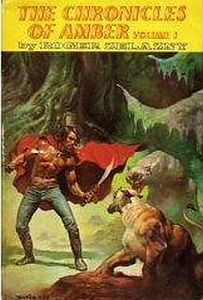
Roger Zelazny, The Chronicles of Amber
Although I read these books awhile after my first early forays into sci-fi and fantasy, The Chronicles of Amber have exerted the second-strongest long-term influence upon me after The Lord of the Rings. Corwin of Amber is probably my all-time favorite fictional protagonist, and the first-person point of view and the gonzo setting of the Amber books simply can't be beat. These books deeply influence how I see magic and multiple dimensions working and interacting -- in fact, certain legendary Lands of Ara NPCs like Morag the Arch-Summoner* exist largely because of how captivating I find the concept of the princes of Amber and Chaos sneaking between dimensions via manipulation of Shadow. It rocks! And Zelazny's imaginative integration of mythical and folkloric beasts into the whole setting is damn memorable too. Hmm, perhaps it's time for a re-read?


Edgar Rice Burroughs, A Princess of Mars etc.
I read ERB's Barsoom books early, like in seventh grade or so, and I really loved them a lot. The world of Barsoom was so evocative for me; I can still see John Carter leaping around on those weird landscapes. Via ERB, I got into the whole science-fantasy mashup genre pretty early, though my D&D / LL campaigns favor an at least superficially Tolkienesque feel and look to them. Yet I nearly always throw a crashed spaceship or some aliens or some inter-dimensional travelers somewhere into my FRPG campaigns, and it's because I have always loved that blending of fantasy and sci-fi found in the Barsoom books (and in Roger Zelazny’s Chronicles of Amber).


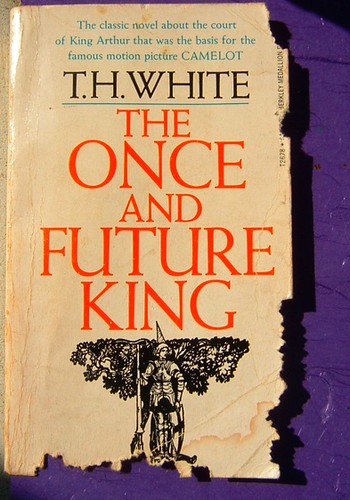
T.H. White, The Once and Future King
Merlin is my third favorite wizard after Tolkien's Gandalf and Monty Python and the Holy Grail's Tim the Enchanter (see next entry). I enjoy Merlin a lot because he is often portrayed as quite Druid-y and pagan, as in The Once and Future King when he turns Arthur into lots of different animals (including an ant!). White's interpretation of the rise and fall of King Arthur is sufficiently epic but primarily human in scale; it is also very funny, as in the sequences involving King Pellinore. But what I like best about this novel, or consider most influential upon my gaming, is its conception of magic: Merlin, Morgan le Fay, and other arcane types in this book (and in the film Excalibur) show us that arcana is nature-based and way more powerful than any single individual's ability to control it. I like that. Magic should never be totally rational nor masterable, and I think I drew that idea largely from Tolkien and White.


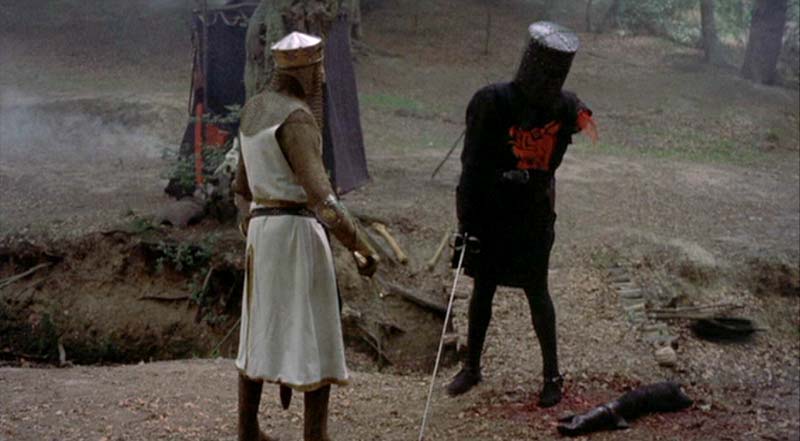
Monty Python and the Holy Grail (1975, dir. Terry Gilliam and Terry Jones)
Like it or not, I love humor in my RPG's. I love grotesque comedy in general, and have been particularly inspired by The Holy Grail's Black Knight fight scene. I love the extreme volume and distance of the blood spurts once the Black Knight starts getting dismembered by King Arthur, and have long attempted to emulate that feel when announcing the combat results in my campaigns: blood and internal organs spurt intensely and far, and a surprisingly large number of blows land in the genitals. As one former player put it, my campaigns seem to take place in a “high-pressure world” where everybody’s blood and internal organs are under a lot of pressure, so as to shoot out really far once pierced in combat. I attribute this trend to Monty Python and the Holy Grail.


Krull (1983, dir. Peter Yates)
Again, Krull's mix of sci-fi and fantasy always worked well for me; this movie was a particular favorite of mine when I was a young lad. It's very D&D ish actually, with its rag-tag party embarking upon a perilous mission across many strange lands. Great stuff! And that magical glaive thingy was bad-ass.


And to conclude, here are a few things I've read lately that I hope will influence my game:


H.P. Lovecraft, The Call of Cthulhu and Other Weird Stories
Please see my review of this volume for more detailed comments, but in short, "HPL's command of written English is nothing short of dazzling. His prose manages to be just rich enough to paint a convincing picture of (creepy) set and (uncanny) setting without stepping over the line into overwrought "purple prose" a la many of Tolkien's descriptive passages or even our own beloved EGG. In short, I find HPL's language to be as evocative as Tolkien's but, at the same time, much more concise."


Lord Dunsany, The King of Elfland's Daughter
I will defer to Cyclopeatron's description: "Style and language. Where fairy tales and dreams intersect. I want stars, moss, and woodsmoke at my table. Dunsany is peerless when it comes to fantasy imagery." Agreed!


P.S. Vance, here I come!

--
* As is briefly mentioned here, Morag the Arch-Summoner is a legendary Arandish wizard who has lived in total secrecy for the past hundred years. He may even be dead or residing permanently in another dimension for all anyone truly knows. Even before his disappearance from human society, Morag was thought to be quite insane. In more recent news, the party in my current Arandish Campaign have found and identified artifacts seemingly related to Morag's cryptic activities.

Monday, January 7, 2013

Helmets Shall be Split in Twain!

Despite a rather busy holiday season so far, I have been keeping both of my main gaming groups going: the Skype-based "home" Labyrinth Lord campaign, and the campaign I run out of  Lift Bridge Books, the local book shop.

The latter group just met yesterday and continued its adventures marauding around in a parallel dimension dominated, on the one hand, by the vast, human-dominated city of Vornheim and, on the other, by a sinister Citadel commanded by a society of Dark Elves.* That gaming group is really picking up steam despite some wavering attendance over the holidays: yesterday our two regular core attendees were there plus two others, making a total of four players plus me.

A photo from a late November meeting of the Lift Bridge Old-School D&D Group.

During the session, one player made a pitch for an extension of the "Shields Shall Be Splintered!" rule, i.e., the "Helmets Shall be Split in Twain!" rule. It would work the same way as the Shields variant, but with only a 2 in 6 chance of working when invoked:

Upon a successful 2 in 6 roll, a helmet may be used to "soak" damage from a single attack, thereby reducing damage to zero. Soaking damage destroys the helmet; it is split in two.


--
* Once the group entered this dimension -- by opening a magical trunk in the underground lair of Zappo the Mysterious -- I had my first chance to use Vornheim, Zak S.'s fucking excellent city gaming supplement. (plans for a review in the near future). For the alternate dimension's Drow-inhabited lands I am mostly cherry-picking stuff from D3 Vault of the Drow.

Saturday, September 22, 2012

Starting Campaigns in Established Settings


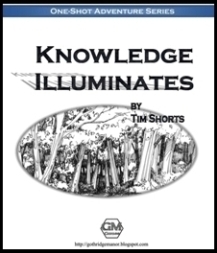
As my contribution to Dice Monkey's September blog carnival, I want to speak briefly about my repeated use of Tim Shorts' excellent  "Starter Adventure" Knowledge Illuminates (published by GM Games) as an inception point for a larger campaign. I have run the adventure twice now, and have found it to be a superb campaign-starter, in part because it avoids the four pitfalls mitigating against good (mega-)dungeon design recently noted by Peter D at Dungeon Fantastic:

1) too much useless backstory
2) slow starts
3) random encounters
4) too many encounters


As I noted in my review of the adventure, "it is the balance the module achieves between keeping it simple -- the scenario itself is quite straightforward -- and offering exciting possibilities for further adventures and/or campaigns" that make it such a valuable and worthwhile gaming product. Since that review was written, I have run the adventure twice, and have found that, just as I predicted, it does indeed give just enough enticing detail to hang custom adventure hooks upon without overburdening the scenario with "useless" or excessive backstory elements. Hence, while KI is NOT a full-blown "campaign setting" in the literal sense of that term, it provides enough of a thumbnail sketch of one to count as an implied setting, especially for an old-school DIY'er. One key feature of the scenario that I do not want to Spoilerize here absolutely sets the world of KI apart (in my mind) from many other settings and implies a great deal about how arcane energies can or might function in any campaign emanating therefrom.


Knowledge Illuminates also avoids the "slow start" problem because it is, on one level, intended as a simple, stand-alone adventure, hence it does not waste time with tons of setting details I would rather fill in myself or in collaboration with my players. The number and types of encounters in the module are pitched very well -- it is well-balanced IMO. I have really enjoyed running it and have found it to be as good a campaign "setting" as any I have ever used.*

--
* To be fair, I must confess that I have never actually used any pre-published "Campaign Setting" unless you count the one sketched and/or implied by what Al Krombach calls "the original adventure path" of TSR modules G1-2-3 and D1-2-3. As I have written before, and similarly to Al, I started out in this hobby playing mostly TSR modules, then moved on to playing exclusively in my own Lands of Ara setting in the 1990s. Hence, maybe I cheated my way around the intent of the Blog Carnival theme -- but isn't that awfully old-school of me?

Sunday, May 20, 2012

FUDGE Star Wars Begins!


We played our first session of FUDGE Star Wars today, and it was a total hoot! Of course, the Star Wars universe -- especially with most of the ridiculous prequel material excised -- is particularly fertile ground for fast-paced science-fantasy adventure. Our campaign is set just before the events of Episode IV: A New Hope, with a revised back story that largely ignores the prequel trilogy.

We PCs are a crew of a Firefly class smuggler ship (yes, we are source-mashing here!) of which my character, Corellian smuggler Jackson Tarkanian, is the owner / captain. My companions include a Jedi knight, a bounty hunter, and a mentally unstable Dug.

My character's "Firefly" class ship, the Starblazer.

We began our adventure marooned on (where else?) Tatooine, looking for ways to earn credits with which to repair our ship. Luckily, Jabba the Hutt was looking for some desperate bounty hunters for a dangerous mission, and we accepted.

Due to time constraints, we did not get very far into the adventure itself -- we mainly looked for rumors (and got embroiled in a drinking contest) in the famed Mos Eisley cantina. Character generation ate up a good portion of our afternoon, but those familiar with the FUDGE System RPG know that chargen is a big part of the fun, especially for the ways in which it encourages players to interweave their characters' back stories and intertwine their fates. Indeed, as I have said before, the best thing about FATE / FUDGE* is the way in which its "Aspect" subsystem encourages good role-playing. In fact, one of our players who DM's a d10-based Wild West RPG with a different group has said that he now uses the "Aspects" subsystem from FUDGE in his own (non-FUDGE-based) game. In other words, this is a subsystem that could be grafted onto practically any existing RPG.**

If you haven't looked at FUDGE before, I would strongly encourage you to follow this link, download the "FUDGE 1995 Edition," and check it out for yourself!

Greedo didn't shoot shit!

More to come on my future plans for FUDGE. . .
--
* FUDGE is the "official" name for this RPG: it is an acronym which stands for Freeform Universal Do-it-Yourself Gaming Engine and was written by Steffan O’Sullivan. Fate RPG is a game based upon the FUDGE system, and I sometimes use the names interchangeably, though I may be doing Fate an injustice by so doing since I know nothing about it specifically.
** I would add that our Star Wars referee, Cid, has come up with a few additional guidelines for use with the FUDGE system, all of which deal with "tagging" and/or "compelling" Aspects. I may eventually publicize and discuss Cid's enhancements here, though I have it on good authority that he is developing his own website. . .

Tuesday, April 24, 2012

Proto-Domain Level Play in Ara

ckutalik over at Hill Cantons recently made some really smart observations about the implied Domain Game rules to be culled from the class descriptions in the AD&D Player's Handbook, including:

Only clerics, fighters, and magic-users are able to exert political authority enough to be able to squeeze income out of a local population. Furthermore they collect this revenue in varying amounts implying that the classes have different spheres of activity in the realm that [they] can control.

I find this post interesting and timely because in my current Lands of Ara campaign, many party members are creeping up toward levels 6 and 7, i.e., they are approaching name level. Innominus of Endra is the closest -- he just reached Cleric level 7 a few sessions ago. Then, just two sessions after that, the priest of Endra was granted sufficient land and funds with which to begin construction of a Temple to his deity in south Minoch.*

Discussing the role of clerics in domain-level play, ckutalik tells us that the Players Handbook says:

Clerics [. . .] can build a temple and attract followers but not tax [. . .] at 8th level.

At 8th level [clerics] must build “a place of worship, a building of not less than 2,000 square feet in floor area with an altar, shrine, chapel, etc” to attract followers. At 9th level to rule they have the: “option of constructing a religious stronghold. This fortified place must contain a large temple, cathedral, or church of not less than 2500 square feet on the ground floor. It can be a castle, a monastery, an abbey or the like. It must be dedicated to the cleric's deity (or deities). The cost of construction will be only one-half the usual for such a place because of religious help.”

So in terms of the proto-domain game in my current campaign, Innominus is seemingly right on target, possibly even a bit ahead of the curve.

Okay, that covers our cleric. As for magic-users, Hazel (currently MU-4) has announced her extended hiatus from the campaign, so Vivuli is our only contender in this area, and my perception is that he considers himself an assassin first, and an arcanist second. Of domain-level assassins ckutalik writes that:

Like thieves, [assassins] cannot build strongholds but can build guild headquarters when they reach 13th level and defeat the sitting guildmaster “the headquarters...is always within a large town or big city...It is typically a warehouse or other nondescript structure, with safeguards and traps added.”

He adds that:

As [assassins] reach name level they must fight and defeat increasingly smaller circles of high-level characters (and presumably must be fielding the same from NPCs and other PCs) culminating in a single character of the highest level.

If Vivuli decides to foreground his wizardly role more so, he may decide to build a wizard's tower and take a more active role in local/regional rule, but I suspect that his player's proclivities -- and his multi-classing as an assassin -- will prevent this.

Of dwarves we learn that:

Level-caps make [the domain game] a humanocentric part of play for PCs. Only Dwarves with 18 STR [. . .] can become name-level fighters. [. . .] So ruling is really left as far as PCs go to humans.

Obviously, these restrictions do not really apply to my Labyrinth Lord campaign, in which we are using the Dwarf race-as-class. In the LL ruleset, dwarves can reach level 12, and are permitted to create a dwarven stronghold starting at level 9 -- see Labyrinth Lord p. 10.

Furthermore, campaign-setting-wise, the Lands of Ara are a bit less human-o-centric than standard AD&D, at least as things are unfolding in the current campaign. Humans still hold the vast majority of power positions, but our own campaign has seen Yor the Dwarf ascend to a position of considerable political influence in Minoch. This makes sense: dwarves are by far the most numerous and economically influential of the Arandish demi-human races, and Yor is rising to power in a region heavily populated by dwarves -- dwarves who are beginning to act on their desire to challenge the dominant human power structure.

Anyway, I will look forward to more of ckutalik's ruminations on the domain game as my PCs move inexorably toward their own version of it.

--
* Session 54, played 3/11/2012, Session Report yet to be written and posted.

Sunday, March 11, 2012

One-Offs vs. Campaigns vs. the Real World

Most of the people I game with (locally and on Skype) are working people with complex family / social lives.  What this means is that there are many opportunities for "life to get in the way" when planning game sessions, especially when conceived as a regular group of players participating in a coherent ongoing campaign.

This phenomenon was made super-clear earlier today, when our Brockport-based RPG'ing group's referee took ill at the last minute.  None of the rest of us were prepared to take up the mantle and run anything, so we simply canceled the session outright.  However, due to a communications foible, one of the players showed up at my house anyway, and he and I got into a discussion about how to protect our group in the future from the ravages of (perfectly understandable) last-minute cancellations like this.

The player in question happens to be a longtime RPG'er and referee himself, and he came up with a brilliant, elegant solution to our conundrum: abandon the concept of a continuous campaign altogether, in favor a of a series of one-off adventures.  That is, each time we meet every two weeks, we simply decide on the spot which game / adventure to play.  One or two referees come prepared with a one-session adventure concept (I have a purchased module I already plan to run as my first one-off session) and some pregen PCs, and off we go!  One session = one game = one adventure!  We choose between whoever is ready to run something each week.

This more flexible, modular approach will potentially solve two longstanding problems we've had in the Brockport RPG'ing group:

(1)  We have a somewhat rotating cast of players; one-offs should make it easier for players to jump in and out, hence encouraging the sporadic players to actually show up, and

(2)  Even the three or four of us who show up every single time have not been able to get one consistent campaign going because of referee illness (like today) or lack or preparedness (as I was exhibiting for awhile when running The Lost City, hence my hiatus until summer).  A rotating series of one-offs frees any one person from constant preparation duties, and really should take less overall preparation for whomever does step up to the plate; it is a smaller commitment.

That is the thinking anyway.


Sunday, March 4, 2012

Campaign Updates and Fudge Dice

I have been falling rather behind on my campaign play reports.  My Skype-based "Arandish Campaign" group, whose Session 49 report posted yesterday, just played their Session 53 a few nights ago!  So my reports are lagging four sessions behind at this point for that group.

My Brockport-based Lost City group has played four sessions, which brought them to the gates of the Underground City. However, following that fourth session about a month back, I declared a temporary hiatus from that campaign until the end of my current academic semester in early May.  My work schedule right now is just too intense for me to successfully referee two different campaigns simultaneously; I will be able to shoulder that responsibility come summertime.  The Brockport group will resume its adventures then, once my schedule lightens up a little.

Meanwhile, Cid, one of the players in my Brockport Campaign, has introduced me to the FudgeRPG system by starting up a game of Diaspora.  Not only am I thrilled to have the chance to be a player in an RPG campaign, which really is a necessary relief for those of us who referee a lot, I am doubly excited to be playing in a hard sci-fi type campaign setting using the Fudge system.

Science fiction-wise, I have a long history with Traveller, have played West End's Star Wars RPG before and even played Shadowrun for awhile in college.  But I have rarely participated in an ongoing hard-sci-fi RPG campaign.  Luckily, Cid is a great referee, and he is doing a great job walking me and three other players through the intricacies of the Fudge system, which I am coming to appreciate and rather enjoy.

In fact, so taken have I become with basic mechanics of FudgeRPG that I ordered my own set of those cool Fudge dice, pictured here:

My new Fudge dice.

I love the simplicity of the Fudge system, the way it kind of sidesteps/minimizes the number crunching aspect yet still allows for exciting (and very easily comprehensible) die rolls. I like its unique take on die-rolling mechanics -- easily emulated with standard six-siders, but more fun with the real thing -- and I am becoming curious about how I might find more uses for these dice.

Are there any Fudge-system aficionados out there who would like to comment about the system, point me toward resources/blogs, and/or share experiences?  Anybody found any cool uses for these interesting dice in the old-school D&D context?

Anyway, those are my updates. 

Charlie the cat inspects my new Fudge dice.

Sunday, February 5, 2012

The Assassination Solution?

I have posted before about my concerns over the Advanced Edition Companion Assassin class, and I have even made a "Decree" in an attempt to severely limit the in-game application of the class's "Assassination" ability.  Yet in explaining the Assassination Decree to Vivuli's player at a recent session, I could tell that he wasn't real happy to be losing what is probably the most potent ability the class is given in the AEC.  I empathize with him and I don't want to hamstring Vivuli, but I also do not like it when an Assassin can instantly kill a balrog or a demi-god with a single percentile roll.

Carl to the rescue!  My good friend Carl has proposed an extremely elegant solution to this problem to me via email, and I want to simply reproduce his idea here:

Here is a quick suggestion to mull over regarding "assassinations". How would you feel about replacing the percent chance to kill mechanic with an attack that does normal weapon damage +1d6 per level of the assassin? All the normal restrictions would apply as specified (the assassin would have to completely sneak up on and surprise the victim, and then actually hit with an attack). The "sneak attack" style of assassination that you dislike is pretty much the whole reason Vivuli's player selected that class, based (I am pretty sure) on a lot of experience playing sneak attack thiefs in the Final Fantasy video game series :) This removes the "magic" element of killing a creature outright and makes it explicitly about just being really skilled at doing damage to an unsuspecting target.

Replacing the chance to just kill outright with a modest damage increase would insure that powerful creatures like the demon/dragon/elemental/lava bird/thing
* couldn't be killed in a single shot. As an example, Vivuli's dagger attack does 1d4 damage, +5d6 for a successful assassination at 5th level would do a max of 34 damage.

This does also keep the ability useful when used against less powerful creatures, guards and the like that would be easily dispatched by someone skilled in the art of stealth who snuck up on them and slit their throat. Against creatures of same HD, it is close to the same percentage chance of killing the creature, but at least your roll as DM when generating the creature's HP gets to go against the damage roll of an attack, instead of an instant death scenario.

One thing to keep in mind is that the Assassin class as converted for Labyrinth Lord is really weak. It is really weak in the original 1e as well. It has the same HD as a wizard, but a wizard has so many more cool powers. The assassin does thief skills like a thief two levels lower. And has worse HD. Really, the whole schtick of the assassin class is the ability to jump out and do a lot of damage in a single surprise attack. It is a limited ability - if it fails, the assassin is standing there with all the d4 HPs dangling in the breeze in front of your big bad monster. My feeling was that converting the ability to a damage increase and abandoning the percentile chance of death might make the entire class easier to stomach for you. It is a sort of specialized combat class that excels in sneaking around and being ninja-y and jumping out and surprising shit with a big attack. I don't think it has to stretch any kind of understanding of what is a magic ability and what isn't.

It doesn't change the relative power that much of the class one way or the other, but it does avoid the percent chance of instant death. It also gives you a very easy way to make sure that a creature does not get instantly killed - just give it a few extra HP!

One other nice thing is it eliminates the d30 wonkiness when interacting with a percentile chart.


Agreed, and so thanks Carl for coming up with this lovely solution.

Any thoughts anybody?

--
* The "thing" Carl refers to here is a being the Arandish Campaign group encountered in a recent session (#51).

Saturday, November 5, 2011

Thoughts About Skill Systems

I was chatting with Spawn of Endra the other day about Bards and multi-classed characters in old-school Labyrinth Lord-type games. As regular readers know, our own gaming group has struggled mightily over the issue of how to integrate a Bard class into our present campaign, and to be blunt, I am STILL not 100% satisfied with what we've come up with, as I recently confessed.

The problem stems from the "skill system" conundrum observed by so many other grognards. And that conundrum originates with the Thief (not the Bard) class, though the problem carries forward into all other "special" classes outside the "core" classes, which I define (at least provisionally) as Fighter, Cleric, and Magic-User, plus the race-as-classes such as Dwarf, Elf, Halfling and (in Ara) Rodian.

That's right, I am officially going on record now as excluding Thieves from the core D&D classes, even though they appear as a "core" class in Labyrinth Lord. To be clear, I do not mind the concept of a thief, i.e., a specialist who develops expertise in certain areas like finding traps and picking pockets. Nor do I mind the general concept of Bards, i.e., experts in folklore and public performance and storytelling and the like. No, I actually really like these "specialist" classes for their core concepts, I just despise what the grafting on of skill systems does to the game, specifically the way in which it can interfere with player ingenuity and role-playing.


Let me give a few examples. The first couple will relate to my experiences DM'ing Uncle Junkal, our party's Rodian Bard, and just let me make clear right out of the gate that I do NOT blame Uncle Junkal or his player for these disappointments of mine. They are ultimately my responsibility for not seeing how the Delving Deeper Bard, as good as it is, participates in the form of "skill resolution" that started with the introduction of the traditional Thief class and ultimately kind of dampens things for me. So this is My fault, which is why I am discussing it now, in an attempt to fix it while still being as fair as possible to my current PCs.

Example #1: Uncle Junkal Charms Grand Vizier Krock. Back in Session 35, our beloved rodian bard used his charm person ability to place himself in the good graces of Prince Arkus' right-hand man. This whole episode was brilliantly role-played by Uncle Junkal's player: he used his juggling and entertaining skills to get near the Vizier, then, after amusing him with some tricks, started asking him innocuous questions about the Prince's visit and the like. He built trust with the charmed Krock, so by the time he started planting ideas about the the local dwarves, it made sense that the Vizier would listen to him. It was a delight to see this unfold even though it did involve an initial successful 2d6 Charm Person skill check, as we developed for our Arandish Bard Class.

A Solution: No skill roll needed? Maybe just role-play it out as we did anyway? What did the skill roll really lose us or gain us? Is it necessary?

Example #2: Uncle Junkal deciphers the significance of Ponaturi Runes. Just this last session or two, the Bard has been using his Legend Lore ability to decipher the meanings of runes inscribed on the pillars and doors around the Temple of Thoopshib.  This has been going okay all in all, but I have found the skill roll itself to be intrusive.  Being the great player he is, Uncle Junkal's player always explains and justifies how he would know certain things in-character; in this case, he would know seagoing legends about Thoopshib due to his background as a rodian, which is a seafaring culture. 

A Solution: The player and I related Uncle Junkal's bardic knowledge to the rodian's background and back story anyway, so again, what function did the roll serve? Did we need it?  Or am I just nitpicking?

UPDATE! Since writing the introductory remarks and examples above, I have played one more session with the group and actually have found Uncle Junkal's skill rolling far less obtrusive this time.  I did not mind the Legend Lore rolls he made; I just, if you'll pardon the pun, "rolled with it." And it worked out fine. I guess it IS kind of old-school to trust the roll of the dice, and perhaps I should appreciate the random element (and hence excitement) skill rolls introduce into the game. With the roll of the dice, it cuts both ways: I think the Bard actually failed more Legend Lore rolls than he made last session. There were surely a couple times when he failed to recognize some potentially important rune.   So maybe I am making a bigger deal of this skill system thing than it needs to be. Yet. . .

Example #3: Vivuli "Assassinates" Thoopshib. In Session 44, Vivuli snuck up on the physical manifestation of the demigod Thoopshib and, upon successfully sneak-attacking it, made a roll to assassinate it. Now this makes about as much sense to me in retrospect as Uncle Junkal charming an extremely hostile, human and demi-human-hating rock troll does, but I tend to be indulgent of my players' whims in the heat of the moment, and given that we were in the climactic seconds of a pitched melee battle, I allowed Viv's assassination attempt to occur. Note also that for that attempt Vivuli's player rolled "00" on his d%, which would technically be a critical failure, NOT a critical success! So it was fucked in every possible way. But what I SHOULD have done was to grant Viv his sneak attack bonuses and let him attack the thing normally -- it really WASN'T a proper assassination attempt, which should be pre-planned and done for political reasons or for hire. In other words, in this case I FAILED to push Viv's player to role-play it out or justify it. Perhaps understandable under the circumstances -- I did not see it coming -- but nevertheless a misapplication of the rules (or at least the spirit of the rules) as far as I am concerned. My bad for not catching it sooner.

A Solution: Enforce tighter restrictions on what counts as an "assassination" [any suggestions about this from the blogosphere?] and remember that a sneak attack and an assassination are two different things, even though they may often (in practical play situations) coincide.

Some tentative conclusions (?): In some ways the bane of my existence as a Labyrinth Lord has been my open-door policy toward the content of the Advanced Edition Companion. The spells and monsters therein are easily added to basic Labyrinth Lord without disrupting things at all, but the new "advanced" classes can be troublesome, and the rules for "Multiclassing" open up dangerous doors as well, as Telecanter has discussed here and here. Nothing against Vivuli, who I love, but I see now that I should not have let Assassins (as writ in the AEC) into the game. Hell, I don't even want standard Labyrinth Lord Thieves in my game! If anything, I should treat Assassins and Thieves exactly as I would prefer to treat Bards -- as Specialists, using a "x in 6" skill system, as in LotFP Grindhouse.

Why? Because James Raggi's system accounts for specialized skill use while retaining compatibility with certain "basic skills" that ALL PCs (regardless of class) can perform, like searching for secret doors and hearing noises. Since everybody has a base 1 in 6 chance to do stuff like that anyway, Raggi's Grindhouse Rules maintain, why not simply have "thieves" be people with a slightly increased chance to do the same stuff? As James Maliszewski has written, ALL older edition D&D dungeoneers are assumed to be de facto thieves:

"the Thief is a self-justifying class. Prior to its introduction in Greyhawk, pretty much every "thief ability" was something a character of any class might attempt. Listening at doors? Check. Moving silently? Check. Locating and disarming traps? Check. The list goes on. I've noted before that 'thief' is an occupation that could describe characters of any class."*

According to this line of thinking, it really doesn't make sense to have separate "thieves' skills" in the game at all. No, "thieves" would more properly be adventurers who happen to specialize in those kinds of dungeoneering skills instead of focusing more effort on, say, martial prowess or the arcane arts. So it's better to call them Specialists if you need to differentiate them from the other PC classes, since ALL PC classes are thieves!

--
* Interestingly, in this same post, Maliszewski goes on to defend the existence of the Assassin class. It also worth noting that over time, Mr. M. made peace with the thief class -- see his discussion here and here, and his final result here.

Saturday, October 8, 2011

Answering Jeff Rients' Twenty Questions (Part 2 of 2)

This post is part two of a two-part series in which I attempt to answer Jeff Rients' list of "Twenty Quick Questions for your Campaign Setting." My first ten answers are here, and Jeff's answers about Wessex are available here and here.

So here is Part 2 of "Twenty Quick Questions for The Lands of Ara":


11. Where can I hire mercenaries?
Almost anywhere in the areas right around the Bay of Noffel -- i.e., the Free City of Kaladar, the Noffellian port towns of River's End, Silverhilt, and Jakama, and/or the Blintian bayside metropolis of Blintsport. In the north, your best bet is Tradefair or Ironcrown, though a certain number of B-grade mercs and swamp-lurking types are probably available in Swampsedge.

12. Is there any place on the map where swords are illegal, magic is outlawed or any other notable hassles from Johnny Law?
Arcane magic is outlawed in Noffel, upon punishment of exile (for the most minor infractions) or death (for everything else). And in general, as far as law enforcement goes, the Noffellian High Guard, the Kaladarian Royal Guard, and the Telengardian Roughriders are the most feared, manichean organizations in the Lands.

13. Which way to the nearest tavern?
I have blogged about this before, but now, thanks to the travels of my current PC party, I can happily add a few more entries to the list of Noteworthy Inns and Taverns of Ara. Here are some key establishments the PCs in my current campaign have visited during their adventures so far:

in Fortinbras
- The Drunken Yeti, the local adventurer's bar
- The King Hargon Inn, a reputable dwarven inn

in Farn Junction
- The Lazy Basilisk, an adventurer's bar
- The Stone Mountain Inn, a dwarven establishment

in the Free City of Kaladar
- The Orc's Balls Inn, a somewhat seedy establishment near the South Gate
- The Greedy Lion, in the North Wall District

In general, it is not difficult to find a drinking establishment anywhere in Ara, though many Noffellians tend to be restrained drinkers or even teetotalers, as are some fairly extreme Telengardians.

14. What monsters are terrorizing the countryside sufficiently that if I kill them I will become famous?
There is always Krakko the Iron Drake, who is so notoriously hated and feared that his death and killer would be celebrated forever throughout the Lands of Ara and beyond.  More realistically, there is a greatly feared red dragon named Razgar who terrorizes northern Ara, a rumored Troll-King in the wildlands down south of Mizar, and many notorious hobgoblin tribes in the northeastern dwarven lands and in the central Minochian mountains.  Lately, there seem to be a great many black dragons terrorizing central and southern Ara as well. And lastly, in the region of the Great Western Swamp, anyone who could exterminate a sufficient number of swamp trolls so as to reduce their deleterious impact on towns like Swampsedge and Sluggerton would be thanked, rewarded, and revered in that region for years to come.

15. Are there any wars brewing I could go fight?
Yes, the so-called New War between Delzar and Mizar, which is really just a long, drawn out border dispute, but no less violent or bloody for it: a great many Mizarian, Delzarian, and mercenary lives are lost to this longstanding conflict every day.  At the opposite corner of the map, there are (rumored) skirmishes between elven and rodian forces taking place in the far northwest, near the western Arandish sea coast on the city of New Port. And of course, there is constant territorial infighting in many places throughout the Western Lands.


16. How about gladiatorial arenas complete with hard-won glory and fabulous cash prizes?
Arenas and gladiatorial battles (to the death anyway) are considered somewhat uncivilized in southern Ara, though there is a famous old arena in Highgate, nowadays only used for ceremonial purposes. However, there is a thriving gladiatorial circuit in the Western Lands and parts of Telengard: Ironcrown, Tradefair, and even Swampsedge all contain active gladiatorial competitions.

17. Are there any secret societies with sinister agendas I could join and/or fight?
The most noteworthy (or notorious) of these would include: (1) the Red Hand, a super-secret assassins' guild supposedly based in Kaladar, (2) the Invisible Hand, a secret society of powerful wizards who resist Arandish law, refusing to join the Council of Arlon, and (3) various dragon cultists, the most terrifying and evil of these latter groups being the one that worships the aforementioned Krakko. 

18. What is there to eat around here?
This is the hardest one to answer, and it varies regionally.  The lands immediately surrounding the Bay of Noffel, i.e., Noffel and Blint, serve a lot of fish and seafood; Blintian mussels are treasured throughout southern Ara.  Minochians herd a lot of goats, but also grow various vegetable and grain crops in the areas east of the high mountains.  The most lush farm- and grazing lands in Ara are in central Achelon and throughout Delzar, so practically any edible crop or form of livestock may be consumed in those Lands or in the Free City of Kaladar.  Despite monster incursions, sheep are raised in many areas of northern Ara and the Western Lands.  Telengard, consisting largely of blighted lands, depends upon local goat-herding as well as imported grain, fungi, and meat from the northeastern dwarves for its sustenance.  Mizarians occasionally herd cattle, and when they do the meat produced is the finest in the Lands, but they mostly prefer to hunt large land mammals (tigers, oliphants, etc.) that roam the southern plains.  And lastly, there have occasionally been unusual fruits and meats brought back by explorers of the southwestern Komar Peninsula, but none of these exotic offerings has yet taken a firm or consistent place in the culinary traditions of the Lands of Ara.

19. Any legendary lost treasures I could be looking for?
Yes, The Crimson Blades.


20. Where is the nearest dragon or other monster with Type H treasure?
Well, converting that "Type H" B/X / AD&D designation into a Labyrinth Lord Hoard Class using my handy-dandy Treasure Type Converter, I see that this query refers to creatures of Hoard Class XV, i.e., dragons and dragon turtles but not much else.  So I would refer you to item 14 above, which is mostly a list of dragons anyway.

Sunday, October 2, 2011

Answering Jeff Rients' Twenty Questions (Part 1 of 2)

Awhile back, Jeff Rients posted a list of "Twenty Quick Questions for your Campaign Setting," which he then proceeded to answer (here and here) for his own Wessex campaign. Inspired by his example, I will now answer those same twenty questions as they relate to the Lands of Ara, to the best of my ability, also in two parts. Here goes part 1:

1. What is the deal with my cleric's religion?
We are discovering that as we play. Some well-known and widely worshipped Arandish deities include Awra, the creator-sorceress; Frey, God of the Noffellians; and Aldor, goddess of the Elves. Innominus, my current PC group's cleric, has suggested that his own order, the Followers of Endra, are a smaller sect, possibly based in the Western Lands, but who (like all other religious groups in Ara) also have a Temple in the Free City of Kaladar. In general, as I have previously posted, "Adventurers in Ara can surely find temples to almost any god or worshippable thing within the walls of the Free City of Kaladar; but outside that city, full-blown temples to anything besides local deities or those entities specifically designated below are probably rare."


2. Where can we go to buy standard equipment?
Any small- to mid-sized town* in civilized areas of Ara would do.

3. Where can we go to get platemail custom fitted for this monster I just befriended?
The Free City of Kaladar. Maybe a few skilled armorers exist in towns with significant dwarven populations like Farn Junction or Ironcrown who could pull off such a task as well.  Of course, no civilized Arandish town or village would allow you to bring your new monster acquaintance inside its walls!


4. Who is the mightiest wizard in the land?
The greatest living thaumaturgist in the Lands of Ara is Arlanni, current head of the White Council of Arlon. However, many Arandish folk believe that Awra herself still roams the Lands, sometimes in Gold Dragon form, sometimes as a human, even occasionally as a rodian. If these legends are in any way true, then the creator-sorceress would rank highest -- for she could surely blow Arlanni out of his booties any day of the week.

5. Who is the greatest warrior in the land?
Officially, whoever is the King of Noffel's current Champion and Captain of the Noffellian High Guard. But that would be a highly contested title, especially outside southern Ara. Usually the head of the Kaladarian Royal Guard is a major badass as well, and there may be other less well-known warriors toiling away in the monster-infested regions of northern Ara who have not been given their due in more civilized circles.

6. Who is the richest person in the land?
I am not completely sure, but I know that he or she surely lives in the Free City of Kaladar. Or possibly is a member of one of the older Noffellian families, or is an Achelonian noble in the Queen's favor who possesses vast tracts of central Arandish land.

7. Where can we go to get some magical healing?
Temples of the Healers of Carcoon abound in most central and southern Arandish towns and cities. Other local and regional sects may offer this service as well.


8. Where can we go to get cures for the following conditions: poison, disease, curse, level drain, lycanthropy, polymorph, alignment change, death, undeath?
The Brothers of Carcoon could do most of these things, but only in their Temples in towns at least the size of Farn Junction, i.e., Medium Towns or bigger (pop. 4,500+).*

9. Is there a magic guild my MU belongs to or that I can join in order to get more spells?
Yes, it's called the White Council of Arlon, and you MUST join it upon reaching name level, or else be hunted down by its (powerful) representatives.

10. Where can I find an alchemist, sage or other expert NPC?
Many good-sized towns in Ara may have such experts, but the larger the metropolis, the better. The Free City of Kaladar is a sure bet, as would be Highgate, the Noffellian capitol. The Delzarian capitol of Bilnhof is also well-known for its high concentration of sages and folklorists.

More Arandish secrets will be revealed in Part 2!
--
* See Labyrinth Lord p. 125 for settlement size categories.